
Inner Peace Techniques: Why we need them, How they work, and How to start today?

Tomek Maciaszek | Inner Peace — Trauma Therapy | Gdynia & online
Why do we need it?
"Be not ashamed to be helped" M. Aurelius
Have you ever forgotten the reason you went to the kitchen?
Have you checked your watch to realize that you haven't noticed what time it was?
Have you been trying to focus on a task, yet random thoughts or simple distractions take your attention away?
Have you been mindlessly scrolling through apps on your phone?
Have you lost your awareness while eating chips and finishing the whole pack?
Have you let yourself be disturbed by an insignificant event in our daily life?
Who can truly admit that they have their thoughts always in order?
Practice of Mindfulness, can help us with these or similar disturbances of awareness.

Inner peace isn't a permanent state to be achieved — it's a capacity to be trained. Through simple, evidence-based mindfulness techniques, you can gradually shift your relationship with your own mind: from reactive to responsive, from scattered to present.
Table of Contents
1. Why We Need Inner Peace Techniques {#why-we-need}
"Be not ashamed to be helped." — Marcus Aurelius
Have you ever walked into a room and forgotten why you went? Checked your watch and had no idea what time it was a moment ago? Scrolled through your phone without choosing to — and then looked up fifteen minutes later, unsure what you were looking for?
Have you been eating chips and realised you'd finished the whole pack without tasting any of it?
These aren't signs of weakness or failure. They're signs of a mind operating on autopilot — the default mode that most of us spend the majority of our waking hours in.
The human brain is extraordinarily capable of multitasking, anticipating, and problem-solving. But this same capability means it's almost never fully present. It's usually somewhere slightly ahead of the current moment, planning and preparing, or slightly behind it, replaying and reviewing.
This automatic, dispersed quality of attention has costs. We miss the texture of experience. We respond to situations with habitual reactions rather than considered choices. We accumulate stress without realising it. And over time — without any counterbalancing practice — the gap between where our mind is and where we are becomes the source of significant suffering.
Inner peace techniques are not about achieving a blissful state of permanent calm. They're about closing that gap — however briefly, however imperfectly — and building the capacity to do so more reliably over time.
As Marcus Aurelius wrote: "Attend the matter which is before thee." This was not passive advice. It was the practice of a man who governed an empire while navigating personal grief, physical illness, and the demands of war. Presence is not a luxury. It is a skill, and one that repays practice.
2. What Mindfulness Actually Does {#what-it-does}

Mindfulness is the deliberate direction of attention to the present moment — with openness and without judgement.
Three words in that definition deserve particular attention:
Deliberate — mindfulness is not passive. It requires an active choice to bring attention to what is happening right now, rather than allowing it to wander by default.
Openness — the quality of attention matters as much as its direction. Approaching one's own experience with curiosity and interest — rather than evaluation, self-criticism, or the need for things to be different — is central to the practice.
Without judgement — not "this thought is good" or "I shouldn't be feeling this." Simply: "there is a thought." "There is a feeling." The practice is one of witnessing, not editing.
One of the most common misunderstandings about mindfulness is that the goal is to stop thoughts. It isn't. Thoughts will arise — always. The practice is to change your relationship with them. Instead of being carried away by every thought as if it were an urgent instruction, you learn to observe thoughts as passing events — like weather moving through the sky. You notice them, and you return.
Every time you notice your attention has wandered and choose to return — that is the practice. Not a failure. One repetition of the most important exercise.
3. The Science in Brief {#science}
Mindfulness is one of the most thoroughly researched interventions in modern psychology and medicine. A summary of what the evidence shows:
Brain structure changes — Research by Sara Lazar at Harvard demonstrated that experienced meditators have measurably thicker cortical regions associated with attention and body awareness, and that these changes are detectable after as little as eight weeks of consistent practice.
Stress and anxiety reduction — Meta-analyses across hundreds of studies confirm that regular mindfulness practice significantly reduces both self-reported and physiologically measured stress and anxiety.
Improved attention and cognitive functioning — Studies show improvements in sustained attention, working memory, and the ability to disengage from irrelevant information.
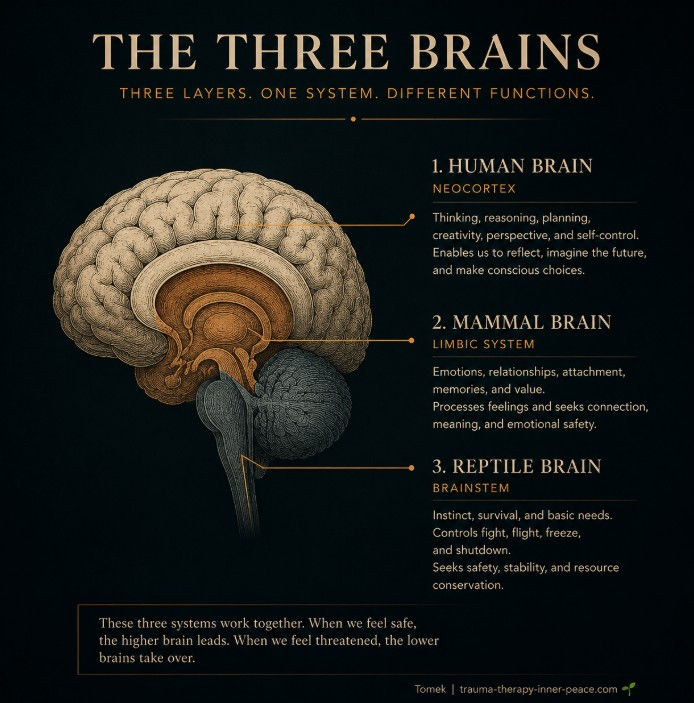
Emotional regulation — Regular practice reduces amygdala reactivity — the brain's alarm centre — and strengthens the prefrontal cortex's capacity to regulate emotional responses.
Physical health benefits — Research links mindfulness practice to reductions in blood pressure, improvements in immune function, better sleep, and reduced chronic pain.
None of this requires hours of daily practice. Research consistently shows that even ten to fifteen minutes daily, maintained over weeks, produces measurable changes.
4. Five Core Techniques {#five-techniques}
1. Mindful Breathing
The simplest and most accessible entry point. Focus your attention on the physical experience of breathing — the sensation of air entering and leaving the nostrils, or the rise and fall of the chest or belly.
Notice everything: is the breath round or irregular? Spacious or tight? Slow or fast? Warm or cool?
Each time your attention wanders — to a thought, a sound, a plan — notice that it has wandered, without criticism, and gently return to the breath. This returning is the practice itself. Do it for five minutes. Then ten. The length matters less than the regularity.
2. Body Scan
Direct your attention systematically through your body — from the crown of the head to the tips of the toes, or in reverse. Pause at each region and notice whatever is present: warmth, tension, tingling, numbness, ease. Don't try to change anything. Simply observe.
The body scan is particularly valuable for those who struggle with racing thoughts — it provides a specific, structured focus that is harder to avoid than the more open space of breath-focused meditation. It also develops what is called interoception — awareness of internal bodily states — which is a foundational skill in emotional regulation.
3. Mindful Eating
Eating is one of our richest sensory experiences — and one that most of us spend almost entirely on autopilot.
Choose one meal or one small piece of food — a grape, a raisin, a single square of chocolate. Before putting it in your mouth, look at it. Notice its colour, texture, smell. Then place it on your tongue and let it sit there before chewing. Notice every sensation: the temperature, the texture, the way the flavour develops. Chew slowly and deliberately.
This is not about eating less. It's about being present for an experience that is otherwise entirely absent from your awareness.
4. Sitting Meditation
Find a comfortable seated position — on a chair, cushion, or the floor — with your spine upright but not rigid. Close your eyes or let them rest softly downward.
Begin by noticing the physical sensations of the body in contact with the surface beneath you. The weight, the pressure, the temperature. Then bring attention to the breath.
As thoughts, sensations, or impulses arise — notice them without following them. Pay particular attention to the impulse to move: when discomfort arises and you want to shift position, see if you can stay with the sensation for a moment before acting. Notice the impulse. Notice how it feels. Then decide consciously whether to move.
This practice develops the capacity to tolerate discomfort without immediately reacting — one of the most transferable skills mindfulness offers.
5. Mindful Observation
Choose an object nearby — a plant, a candle, a cup. Direct your full, unhurried attention to it for two to three minutes.
Look at it as if you have never seen this type of object before. Notice details you usually overlook. The variation in colour. The texture. The way light falls on it. In a plant, the structure of individual leaves, the direction they face, the tiny variations between them.
This practice trains what Zen calls "beginner's mind" — the capacity to meet the familiar with fresh eyes. It is also a powerful reminder that the world contains vastly more richness than our habitual perception allows us to notice.
"Daily and hourly development of our body, mind and spirit attunes us to ever finer currents." — M. P. Hall

5. Building a Daily Practice {#daily-practice}
The most common reason mindfulness practice doesn't take root is that people try to do too much too soon, fail to maintain it, and conclude they're "not a meditation person."
A more sustainable approach:
Start with five minutes. Not twenty. Not an hour. Five minutes in the morning, before you reach for your phone, using any of the techniques above.
Attach it to something you already do. After coffee. Before breakfast. After brushing your teeth. This is how habits form — not through willpower, but through anchoring new behaviours to existing ones.
Use guided support. At the beginning, a guided meditation removes the uncertainty of "am I doing this right" and provides structure. Insight Timer is free and has hundreds of short guided practices. YouTube has countless options. Use them.
Expect your mind to wander. It will. Every time. That's not a problem — it's the practice. Each return is one repetition.
Track progress in weeks, not days. The benefits of mindfulness accumulate over time. Two weeks of consistent practice will produce noticeable results. One week may not. Commit to a month and evaluate then.
6. Inner Peace and Trauma {#trauma}
For some people — particularly those with a significant trauma history — mindfulness practices can occasionally feel destabilising rather than calming. Focusing on the body, or sitting in silence, may activate difficult states: flashbacks, dissociation, or intense anxiety.
If this is your experience, it is not a sign that mindfulness isn't for you. It's information — about where your nervous system currently is, and what kind of pacing and support might be needed.
Many trauma-informed therapists introduce mindfulness gradually and with specific modifications — focusing on external senses rather than internal body sensations initially, keeping sessions very brief, and working within what Peter Levine calls the "window of tolerance."
The goal remains the same: to gradually expand the capacity to be present in the body, in the moment, without it feeling threatening. For people after trauma, this work often unfolds in the context of therapy rather than independent practice — and that's entirely appropriate.
7. FAQ {#faq}
Do I have to meditate every day? Regularity matters more than length. Ten minutes daily will produce more change than sixty minutes once a week. If daily feels unrealistic, start with five days a week and build from there.
What if I fall asleep during meditation? It happens — especially with body scan. Try meditating at a different time of day, in a more upright position, or with eyes open. Falling asleep occasionally isn't a problem; consistently using meditation as a sleep aid rather than a practice may limit its benefits.
Is mindfulness religious? Mindfulness has roots in Buddhist contemplative practice, but MBSR and clinical mindfulness are entirely secular frameworks. They require no specific beliefs and are practised by people of all backgrounds and none.
How do I know if it's working? Watch for: slightly more space between a trigger and your response; more frequent moments of noticing where your attention is; a small but real reduction in the intensity of stress reactions. These are the early signs — subtle, but genuine.
Tomek Maciaszek — certified psychotraumatologist, CPT and PE specialist, Mindfulness practitioner. Gdynia & online.


Comments