
Emotions: The complete guide to understanding what you feel and why

Updated: May 26

Tomek Maciaszek | Inner Peace — Trauma Therapy | Gdynia & online
For a long time I thought emotions were something you either feel or you don't.
Nobody told me you can not know how to name them. That you can feel something in your body and have no word for it. That this inability to name actually makes emotions more intense — not less.
When I started building an emotional vocabulary — literally, a list of words — something changed. Not because the emotions disappeared. But because they stopped being chaos.
Table of Contents
1. What emotions are {#what-are}
Most of us were never taught what emotions actually are. We were told to control them, suppress them, express them appropriately — but rarely what they fundamentally are.
An emotion is a complex physiological and psychological state involving three inseparable components.
Personal experience — the subjective, inner "what it feels like." The warmth of love. The tightness of fear. The heaviness of grief.
Bodily reaction — the physiological changes that accompany and partly constitute the emotion. Increased heart rate, muscle tension, altered breathing, hormonal shifts.
Behavioural response — the impulse to act that emotions carry. Fear urges withdrawal or freezing. Anger urges confrontation. Joy urges connection.
These three components are not separate. They are one event, experienced simultaneously across mind and body.
Darwin in 1872 compared facial expressions and body responses across diverse cultures — from native tribes to contemporary populations across Asia, Europe, and America. His finding was striking: the fundamental experience of emotions is nearly identical across all humans. Fear, grief, joy, disgust — not cultural constructs. Biological facts.
When you feel something intensely, you are not overreacting. You are having a human experience that has been part of our species for millions of years.
2. The Neuroscience: How emotions form {#neuroscience}
Emotions don't arise from nowhere. They have a precise neurological architecture.
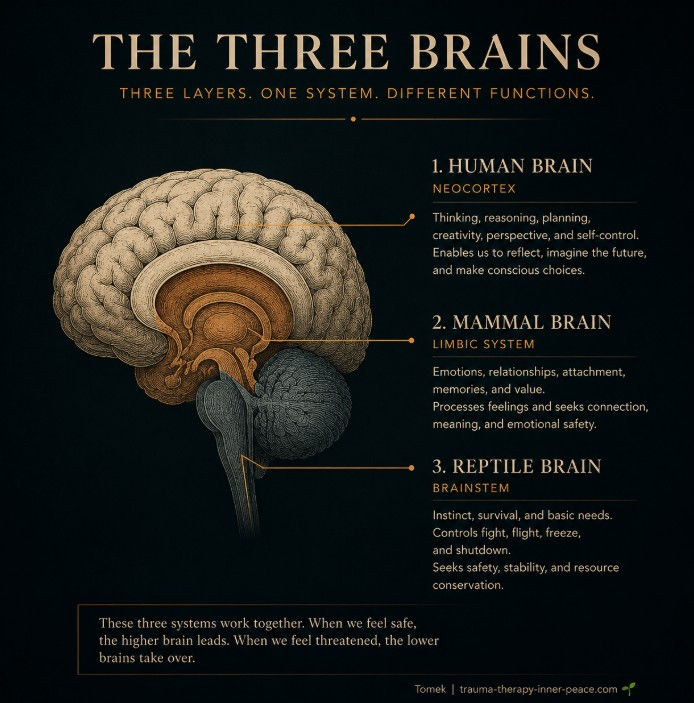
The autonomic nervous system is the primary manager of emotional experience. It operates below conscious awareness and governs heart rate, breathing, digestion, hormone secretion, and muscle tension throughout the body. It has two primary branches.
The sympathetic system activates in response to perceived threat. Produces the fight, flight, or freeze response. Accelerates heart rate, contracts muscles, shunts blood away from digestion, releases adrenaline and cortisol.
The parasympathetic system activates in conditions of safety. Slows heart rate, promotes digestion and cellular repair, enables connection and rest.
Emotions are essentially the subjective experience of these autonomic shifts.
Stephen Porges's Polyvagal Theory identified a third branch — the ventral vagal system — which specifically supports social engagement, connection, and calm aliveness. When this system is active, we can feel, express, and regulate emotions fluidly. When the nervous system shifts into sympathetic overdrive or dorsal vagal shutdown — emotional experience becomes either overwhelming or completely inaccessible.
This explains why people after trauma often have difficulty with emotions — not because they lack emotional capacity, but because their nervous system has learned to operate in modes that restrict emotional access.
3. Natural and learned triggers {#triggers}
Not all emotional responses are created equal. Understanding the difference between natural and learned triggers is one of the most practically useful things in emotional education.
Natural triggers produce consistent responses across all humans and many other mammals. They don't require personal history or cultural conditioning — they're hardwired.
A sudden loud noise → startle and fear. The smell of rot → disgust. Loss of a loved one → grief. Connection and warmth → comfort and joy. Novelty in a safe context → curiosity.
These don't need to be learned. They're inherited.
Learned triggers are responses we've developed through personal history. Any stimulus that evokes a strong emotional response because of its association with a past experience.
Words you heard that felt disproportionate. A specific tone of voice. A scent that carries someone's memory. Music associated with a powerful experience. The way someone touches you. Situations — opening the fridge when hungry, needing to confront someone, certain body positions.
Your learned triggers aren't arbitrary. Each is a record of something your nervous system decided was important enough to remember. Understanding them — rather than being confused or ashamed — is the beginning of emotional literacy.
4. How emotions live in the body {#in-body}
Emotions aren't "in the head." They're in the body — distributed across muscles, organs, breath, and posture.
In 2013 Finnish researchers Nummenmaa and colleagues mapped the body locations of emotional experience across over 700 participants from different cultures. The results showed strikingly consistent patterns: fear activates the chest and head; disgust is felt in the throat and abdomen; love and happiness produce full-body warmth; sadness produces a reduction of sensation.
Bessel van der Kolk's work showed that unprocessed emotions are stored in the body not merely as memories but as ongoing physiological patterns — postural habits, chronic muscle tensions, respiratory patterns.
Working with emotions cannot be only cognitive. The body must be part of the conversation.
5. 10 Key emotional states {#10-emotions}
Anxiety
The body's anticipatory threat response — fear of something that hasn't happened yet. Increased heart rate and shortness of breath, sometimes hyperventilation. The body may sweat and tremble. Muscles tense. Dry mouth. Possible headaches.
Anxiety is a signal, not a sentence. The nervous system saying: I perceive threat — help me assess whether it's real.
Sadness and Grief
The body's response to loss. Breathing becomes slow and shallow, interrupted by deep sighs. Eyebrows raise, mouth depresses — the classic grief expression Darwin identified across all human cultures. Weakness, fatigue, tightness in the chest and throat.
Grief is not an illness. It is the measure of love.
Despair
Arises when grief meets helplessness — when loss feels permanent. Loss of appetite, digestive disruption. Heaviness in the limbs. Fatigue that can mimic physical illness.
Hatred
A rapid, pounding heartbeat accompanied by tightness in the chest. Muscles stiffen particularly in the neck, shoulders, and jaw. Possible trembling. Clenching of fists or grinding of teeth. Flushing and redness.
Rage
Carries all the physical sensations of anger, amplified by an adrenaline surge that creates an urgent impulse to act. Vision can narrow. Some senses become heightened. The body flooded with energy demanding expression.
Key distinction: anger carries information and purpose. Rage is anger that has exceeded the nervous system's capacity to process it consciously.
Contempt
Primarily visible in the face — a tightened jaw, a sneering expression, the upper lip curled to one side. Chest discomfort. Posture withdrawing.
John Gottman's research identifies contempt as the single strongest predictor of relationship failure.
Disgust
Felt primarily in the digestive system. Nausea, gagging, increased saliva production. Wrinkles on the nose and curling of the upper lip. A strong impulse to withdraw from the source.
Evolutionarily protects us from contamination. Psychologically also responds to moral violations.
Guilt
Sweating and dry mouth, particularly on the hands and face. Difficulty relaxing. A shallow, constricted breath pattern — the experience of holding something in.
Guilt is about behaviour: I did something wrong. This distinguishes it from shame, which is about identity: I am wrong.
Pride
A glow of energy and warmth radiating from the chest. The body expands. A natural smile. Breathing deepens. Posture improves.
Pride is a signal that we acted in alignment with our values. It's a healthy, necessary emotion.
Fear
Goosebumps as the body prepares. Pupils dilate. Dry mouth. Cold sweat. Muscles tense throughout the body. Heart rate rapid.
Fear is one of our oldest protective systems. The problem emerges when the nervous system generates fear responses in contexts that are no longer genuinely threatening.
6. 60+ Emotions to eecognise {#full-list}
One of the most valuable things you can do for your emotional health is expand your emotional vocabulary. Research by Lisa Feldman Barrett shows that people with more granular emotional vocabulary experience emotions with less intensity and recover from difficult states more quickly.
Positive/Expansive | Challenging/Contracting | Complex/Mixed |
Acceptance | Aggression | Ambivalence |
Affirmation | Anger | Admiration |
Carefree | Anxiety | Bittersweet |
Tenderness | Arrogance | Confusion |
Determination | Contempt | Devotion |
Empathy | Cruelty | Awe |
Enthusiasm | Despair | Guilt |
Courage | Disgust | Hope |
Joy | Frustration | Jealousy |
Happiness | Grief | Longing |
Kindness | Hatred | Nostalgia |
Love | Horror | Melancholy |
Pride | Laziness | Offence |
Calm | Misery | Reverence |
Confidence | Numbness | Shame |
Gratitude | Rage | Tenderness |
Excitement | Revenge | Wonder |
How many of these do you recognise in yourself? How many do you have words for in the moment they arise?
7. Why naming matters {#naming}
Matthew Lieberman at UCLA demonstrated through fMRI studies that naming an emotion with a word reduces amygdala activity — the brain's alarm centre — and increases prefrontal cortex activity responsible for regulation and clear thinking.
This is called affect labelling. It happens automatically, without effort, simply by having the vocabulary to name the state you're in.
"I feel afraid" is neurologically different from "I feel overwhelmed." "I feel ashamed" is different from "I feel angry." The more precise your vocabulary, the more the brain can regulate.
People with limited emotional vocabulary literally experience emotions more intensely and have less access to regulation. This is alexithymia — the inability to identify and describe emotions — extraordinarily common in people with a history of emotional neglect or trauma.
The good news: emotional vocabulary can be learned at any age. Every article you read about emotions, every therapy session where feelings are named, every journaling practice where you try to find the precise word for what you're experiencing — all of this expands your vocabulary and with it your capacity for self-regulation.
8. How trauma distorts emotions {#trauma}
Many of our internal triggers are hidden from us — yet we experience them rushing for a bus, getting ready for work, talking to people, or simply being alone with ourselves.
Trauma distorts emotional experience in specific, predictable ways.
Emotional flooding. The nervous system becomes hyperreactive. Normal stimuli produce intense emotional responses. The window of tolerance becomes very narrow.
Emotional numbing. As a protective response to flooding, the nervous system moves into a state of reduced emotional access. Emotions that were once available become inaccessible. I feel nothing. Like watching my life through glass.
Alexithymia. Prolonged trauma can impair the development of neural structures supporting emotional awareness and naming. The person genuinely cannot access what they're feeling, even when the emotion is clearly driving their behaviour.
Emotional time travel. Traumatic responses aren't anchored to the present. A trigger activates a response from the past, and the person experiences an emotion with the intensity appropriate to the original event — not the current one. The reaction seems disproportionate to observers but is internally consistent with historical experience.
The path through all of this is the same: slow, patient attention to what the body is experiencing — without pressure to immediately understand or change it.
9. How to work with your emotions {#working-with}
There are no bad emotions. There are only emotions that are understood and those that aren't yet.
Every emotion carries information. Every emotion carries energy. And every emotion, given appropriate attention, will move through — completing its physiological cycle and returning the body to equilibrium.
Step 1 — Notice. Several times a day, pause and ask: what am I feeling right now? Not whether I should feel this — just what is it. If words don't come, start with the body: where do you feel something? Tension, heaviness, warmth, tingling?
Step 2 — Name. Try to give the sensation a name from the list above. Start broad if needed — this is something in the fear family — then try to get more specific. Is it anxiety? Dread? Apprehension? The attempt to name is itself the intervention.
Step 3 — Allow. Rather than moving immediately to analyse or fix the emotion, simply allow it to be present for a moment. An emotion is a physiological event. It has a beginning, a middle, and an end. The biochemical cycle of a single emotion, if not suppressed and not amplified, lasts approximately 90 seconds. What makes emotions last longer is suppression — which stores them — or rumination — which restarts the cycle.
Step 4 — Investigate. Once the initial intensity has settled, bring gentle curiosity. What might this emotion be telling you? What need might it be signalling?
Step 5 — Respond. Only after noticing, naming, allowing, and investigating — decide how to respond. Not to the raw emotion, but from the information it has provided.
Journaling, body awareness practices, breathwork, therapy — all support this process. More on writing in the expressive writing article on this blog.
10. FAQ {#faq}
Can I choose how I feel? Not in the short term — the initial emotional response is largely automatic. But you have significant influence over what happens next. Over time, practices that build emotional awareness genuinely expand your capacity to respond rather than simply react.
Why do some emotions feel stuck? Emotions get stuck when they are repeatedly suppressed before completing their physiological cycle. The body initiates the emotional response — and then it's interrupted before resolution. Over time, this creates chronic physiological tension. Somatic approaches and expressive practices help complete these interrupted cycles.
Is it possible to feel two opposite emotions at the same time? Absolutely. The emotional system is not binary. Grief and relief, love and anger, pride and fear — completely normal and physiologically possible. If you frequently experience conflicting emotions, you are not confused. You are complex.
What is emotional intelligence and can it be developed? The capacity to recognise, understand, manage, and use emotions effectively — in yourself and in relationships. Research strongly supports that it can be developed through practice, education, and psychotherapy. It is not fixed.
What is the difference between an emotion and a mood? Emotions are typically brief, intense, and triggered by specific stimuli. Moods are more diffuse, longer-lasting background emotional tones that colour experience for hours or days — without necessarily having a single identifiable trigger.
When should I seek professional help with emotions? When emotional states consistently feel overwhelming or unmanageable. When you have significant difficulty identifying what you're feeling. When emotions regularly interfere with relationships or daily functioning. When you suspect past experiences are affecting your present emotional responses.
Closing
Emotions are not your enemy. They are not weakness, noise, or inconvenience.
They are the primary way your body communicates with you — about safety, about need, about value, about meaning.
The more fluently you can read that language, the more fully you can live.
Tomek Maciaszek — certified psychotraumatologist, CPT and PE specialist, Mindfulness practitioner. Working in Gdynia and online, in Polish and English.


It’s both informative and reflective—left me thinking about my own emotional patterns.