
How we think and how trauma affects it — A complete guide to the Mind

Tomek Maciaszek | Inner Peace — Trauma Therapy | Gdynia & online
We all think differently — but there is a shared pattern by which we can recognise what's happening in the mind. Our thoughts divide into conscious and unconscious, controlled and uncontrolled. Trauma disrupts this system more deeply than anything else — and understanding how we think is the first step to understanding why we react the way we do.
Table of Contents
1. The Map of the Mind — How Our Thoughts Are Organised {#map-of-mind}

We all think differently. Yet there is a pattern by which we can recognise what is happening in our mind and how we can understand it.
Our thoughts can be divided into two spheres: the conscious and the unconscious. In other words — thoughts we control, and those we don't.
This distinction is crucial, because most of what drives our behaviour, decisions, and emotional reactions comes precisely from that second category — from the unconscious, to which we have no direct access in daily life.
Imagine an iceberg. The tip visible above water — that's our conscious mind. What we're currently thinking about, what we deliberately analyse, what we plan. But beneath the water's surface — a vast mass of ice we can't see — that's the unconscious. Beliefs, memories, emotional patterns, somatic experiences, traumas. Everything that has shaped us over a lifetime and that influences our thoughts, words, and actions every day — often without our knowledge.
Understanding this map isn't an academic exercise. It's a tool that allows you to begin understanding why you think the way you think — and where to look for change.
2. Conscious Thoughts — Controlled and Chosen {#conscious}
Controlled thoughts arising in our consciousness can be divided into two groups: chosen and created.
Controlled Chosen Thoughts
These are things we've consciously decided to explore or chosen to focus on. Whether it's a work task we need to complete, learning to play an instrument, or planning a holiday — we've deliberately directed attention there.
This capacity is managed primarily by the prefrontal cortex — the part of the brain that enables planning, decision-making, impulse regulation, and focusing attention. This is what we mean when we talk about "rational thinking."
The prefrontal cortex is also the last structure to mature during development — it doesn't fully finish forming until around age 25. And it's the first to "go offline" when we're under intense stress or in a strong emotional state — which is why under the influence of fear or anger it's hard to think clearly and make good decisions.
Controlled Created Thoughts — Imagination
The second type of conscious thoughts are those we create through imagination. Imagination connects what we've consciously learned with information stored in the unconscious.
We can see this when analysing art — a song, a painting, a sculpture — and noticing in it the thought patterns of the creator. The artist consciously creates, but the material they draw from comes from deeper layers. The amygdala and hippocampus play a key role in the creative process and imagination — structures deeply involved in emotion and memory.
This is exactly why people after trauma often find creativity and imagination difficult — their amygdala is overloaded, and the hippocampus functions differently than in people without a traumatic history.
3. Unconscious Thoughts — Where Trauma lives {#unconscious}
Uncontrolled thoughts, originating from the unconscious, can be divided into two groups: acquired and innate.
Uncontrolled Acquired Thoughts — The Unconscious Proper
This is the building material of our unconscious. Here are stored:
our beliefs about ourselves and the world
expectations of others and of ourselves
self-worth
somatic experiences — how the body responds to different situations
all our traumas — both "big" and "small"
This information influences how we speak, interact with people, make financial decisions, use our bodies, and interpret reality. All of this often happens without our awareness.
The primary structures responsible for storing this information are the amygdala, the hippocampus, and the prefrontal cortex — the same structures that engage in the stress and trauma response.
Uncontrolled Innate Thoughts — Intuition
The second type of uncontrolled thoughts is intuition. This is a thought process we are born with. If it isn't disrupted, it allows us to read subtle cues about our environment and what is good or bad for us.
Intuition belongs to our unconscious and is often managed by the gut and brain stem — which explains why we talk about a "gut feeling." That's not a metaphor. It's neurobiological reality.
Worth noting: intuition works correctly when the unconscious is relatively clear. When the unconscious is filled with unprocessed trauma and fear — intuition can mislead us. It can make safe situations seem threatening, and threats seem safe.
4. The Thought Diagram — How it all fits together {#diagram}
Below is the complete classification of thoughts that helps understand the structure of the mind:
THOUGHTS
│
├── CONSCIOUS (controlled)
│   ├── CHOSEN
│   │   └── Deliberate focusing of attention
│   │       Prefrontal cortex
│   │
│   └── CREATED (imagination)
│       └── Creative linking of consciousness with the unconscious
│           Amygdala + Hippocampus
│
└── UNCONSCIOUS (uncontrolled)
    ├── ACQUIRED
    │   └── Beliefs, trauma, expectations, somatic experiences
    │       Amygdala + Hippocampus + Prefrontal cortex
    │
    └── INNATE (intuition)
        └── Inborn reading of the environment
            Gut + Brain stem
This diagram reveals something important: there is no purely "rational" thinking detached from emotion and body. Each of the four categories of thought engages both cortical (thinking) and subcortical (emotional and somatic) structures. Thinking is always holistic — even when we believe we're "calmly analysing."
5. The Neuroscience of thinking — What happens in the Brain {#neuroscience}
To understand how trauma changes thinking, it's worth first understanding how thinking works under conditions of safety.
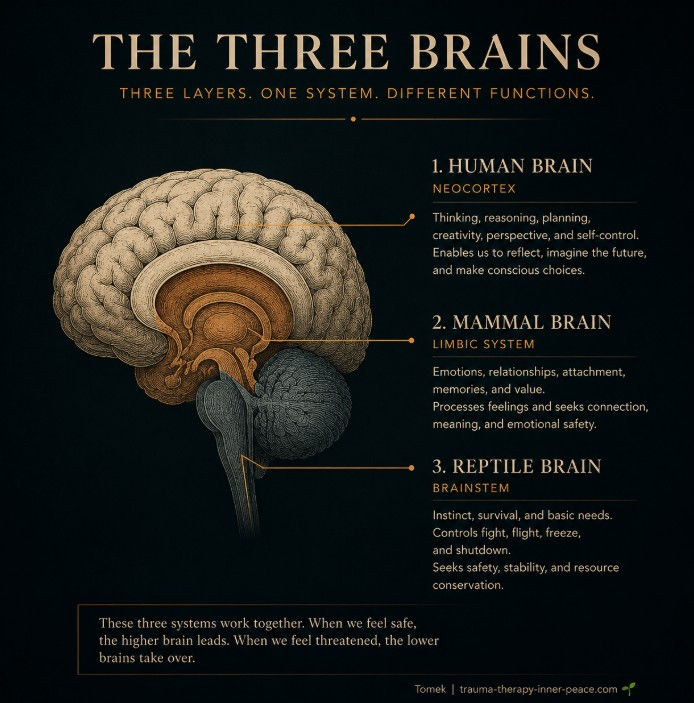
Three Brains in One
Neurologist Paul MacLean described the human brain as a three-layered structure — three evolutionary layers that developed successively over millions of years:
The reptilian brain (brain stem) — the oldest layer. Manages basic life functions: breathing, heartbeat, body temperature. Responds instinctively. This is where the freeze response lives.
The mammalian brain (limbic system) — the middle layer. Manages emotions, attachment, emotional memory. Contains the amygdala (alarm centre) and hippocampus (memory centre). This is where emotions "live" and where trauma is stored.
The new brain (neocortex) — the youngest layer. Manages abstract thinking, language, planning, emotional regulation. The prefrontal cortex is its most developed part.
The problem: these three layers don't always work together harmoniously. Under threat — real or perceived — the limbic system takes over and literally "switches off" the prefrontal cortex. Hence the saying: "fear makes you stupid." This isn't a metaphor — it's a literal description of neurobiology.
The Amygdala — Guardian or Tyrant?
The amygdala is an almond-sized structure deep in the brain that continuously scans the environment for threats. It responds within 12 milliseconds — before consciousness has time to process anything.
Under normal conditions the amygdala acts like a vigilant guard: it detects a threat, raises the alarm, the body responds, the threat passes, the guard calms down.
After trauma the amygdala acts like a guard with PTSD: it sees threats everywhere, reacts to shadows, doesn't calm down even when the threat passed long ago. Because it learned that the world is dangerous — and it holds to that.
The Hippocampus — The Memory Archivist
The hippocampus is the structure responsible for converting current experiences into long-term memories and for giving them temporal context. Normally the hippocampus "knows" that a memory comes from the past — that that fear was then, and now is safe.
Trauma disrupts this function. Under high cortisol the hippocampus performs more poorly — traumatic memories aren't properly "date-stamped." That's why a flashback doesn't feel like a memory from the past. It feels like the present.
6. How Trauma disrupts thinking {#trauma-thinking}
As Pierre Janet, the father of trauma studies, explained back in 1889:
"As long as people are unable to integrate the memories of trauma, fragments of experience keep returning as intense emotions, images, bodily sensations, and irrelevant behaviours."
Unpleasant experiences that we have acquired often rule our lives like a puppeteer — deciding the next move of the puppet we ourselves are. In a dynamic world we tend to chase many distractions, often to numb and anaesthetise ourselves from painful memories that want to leave us.
Trauma disrupts thinking on several levels simultaneously:
Level 1 — Hyperreactivity of the Alarm System
After trauma the amygdala becomes hypersensitive. It reacts intensely to stimuli that are objectively harmless — a tone of voice, a smell, a gesture. This hyperreactivity is particularly insidious because it operates below the threshold of awareness.
Before you have time to think: "is this a threat?" — the body has already reacted. Heart rate has risen, muscles have tensed, breathing has shallowed. And only then does a thought reach consciousness — often a misinterpretation of the situation, viewed through the lens of past experience.
Level 2 — Narrowing of Attention and Thinking
Under threat (real or imagined by the hyperreactive amygdala) the prefrontal cortex is "taken offline" from the main processing stream. Thinking narrows. We lose the ability to see multiple options, consider different perspectives, engage in calm analysis.
That's why in situations that even slightly resemble trauma — people after trauma often react in ways they themselves later describe as "disproportionate" or "childlike." The prefrontal cortex really is less active in that moment. A more primitive layer of the brain is responding.
Level 3 — Frozen Beliefs
As Janet wrote: people unable to integrate traumatic memories seem to lose the capacity to assimilate new experiences. Trauma "freezes" certain beliefs at the moment they were formed.
We may be 40 years old, educated, successful — but when a specific trigger appears, we return to the self of the moment when that trigger was first registered. We feel and behave like a 5- or 14-year-old, leaving ourselves baffled by how we reacted to something that seemed insignificant.
This is the "puppet government" — unconscious beliefs and unprocessed memories that take control of our present.
Level 4 — Disruption of Intuition
Trauma also disrupts intuition — that internal compass that normally helps us assess safety and make sound decisions. When the unconscious is filled with threat patterns, intuition begins to replay those patterns:
A safe person seems suspicious
A healthy relationship seems boring or unreal
Calm seems like anxiety ("something must be wrong if everything is this quiet")
Many people after trauma describe a sense of "making bad choices" in relationships and life situations — and with hindsight see that they were choosing the familiar, even when it was painful. That's not stupidity. That's intuition calibrated by trauma.
7. Beliefs — Frozen thoughts that run your life {#beliefs}
Beliefs are a particular category of unconscious thought — so deeply rooted and repeated for so long that we stop treating them as thoughts. We treat them as facts about reality.
"I'm not enough." "People are dangerous." "I have to earn everything." "I can't trust my own emotions." "The world is unjust and nothing can be done about it."
Each of these beliefs, embedded in the unconscious, acts like a lens — through which we interpret every new experience. An incidental word from a partner gets read as rejection. Constructive criticism at work — as proof of worthlessness.
James Allen wrote in As a Man Thinketh:
"Every thought seed sown or allowed to fall into the mind, and to take root there, produces its own, blossoming sooner or later into act, and bearing its own fruitage of opportunity and circumstance. Good thoughts bear good fruit, bad thoughts bad fruit."
But Allen wrote this in the context of consciously shaping thoughts. Trauma does the opposite: it plants the seeds of beliefs outside our awareness and will — and then makes us live with their fruit, not knowing where the tree grew from.
That's exactly why changing beliefs requires more than conscious intention. It requires reaching the unconscious — where those beliefs actually live.
8. Trauma-Typical thought patterns {#patterns}
Trauma-focused Cognitive Behavioural Therapy (CPT) identifies characteristic thinking patterns that develop as a consequence of traumatic experiences. Researcher Patricia Resick, the creator of CPT, calls them "stuck points."
All-or-Nothing Thinking
"Either I'm perfect, or I'm worthless." "Either I can trust someone completely, or I trust no one." "Either everything is going well, or everything is falling apart."
Trauma often strips us of the ability to see nuance — the grey between black and white. A nervous system in survival mode needs quick categorisations: safe/dangerous, friend/enemy, good/bad.
Catastrophising
A tendency to assume the worst-case scenario. "If I make a mistake, I'll lose my job and everything will collapse." "If I express a need, I'll be rejected."
For a child who lived in an unpredictable or dangerous environment, this strategy was adaptive — better to assume the worst and be wrong, than to be unprepared. In adulthood it becomes a source of chronic anxiety.
Personalisation
A tendency to take everything personally. "If someone is in a bad mood, it's my fault." "If a relationship isn't working, it's because I'm not enough."
Children who grew up in environments where something was "always wrong" often developed the belief that they were responsible for it — because that gave them an illusion of control. "If it's my fault, I can fix it."
Hypervigilance and Threat-Focused Thinking
Constantly scanning the environment for potential threats. Interpreting neutral signals as hostile. Difficulty releasing vigilance even in safe situations.
"Should" Rules and Absolute Standards
Rigid internal rules: "I should always be strong." "I shouldn't need help." "I must always be right."
These rules protect against uncertainty — which for someone who grew up in an unpredictable environment is deeply threatening.
9. Thought, Emotion, Body — The inseparable triangle {#triangle}
Our thoughts very often reflect how we feel.
When we feel safe — thoughts are positive, calm, and allow learning. We see possibilities. We're creative. Curiosity is available.
When we feel threatened — thoughts are negative, pessimistic, full of comparisons, and don't allow easy learning. We see obstacles. We're reactive. Curiosity fades.
But it works in the other direction too. A thought generates an emotion, which generates a bodily sensation, which generates a thought. A closed loop.
Imagine: you have a meeting with a new client. Thought: "I can't do this, I'm not enough." Emotion: anxiety. Body: stomach tension, shallowed breathing, tightened shoulders. This body reaction reinforces the belief: "I feel bad, which means I was right — I can't do this."
Or in reverse: something in a manager's behaviour triggers a bodily sensation — a tightening in the throat, a faster heartbeat (a somatic trigger from the past). The body reacts before consciousness can process. Emotion: fear. Thought: "he doesn't like me, I'll have problems." Even though objectively nothing indicates a threat.
This is exactly why working only with thoughts — as in classical CBT — doesn't always suffice with trauma. Trauma is stored in the body, not only in beliefs. And that's why somatic approaches — which work directly with the body — are so important in trauma therapy.
10. How to change thinking — What actually works {#how-to-change}
Knowing how the mind works and how trauma disrupts it — we can talk about what actually changes thinking. Not through "willpower" and not through simple "positive thinking."
1. Working With the Unconscious, Not Against It
The classic mistake: trying to "switch off" negative thoughts. Research shows that active suppression of thoughts paradoxically strengthens them (the white bear effect — try not to think about a white bear).
A more effective approach: noticing thoughts without judging them, recognising them as a thought (not a fact), and slowly working with the belief that underlies them.
2. Nervous System Regulation as the Foundation
No cognitive work functions effectively when the nervous system is in a state of strong activation. That's why regulation techniques — diaphragmatic breathing, mindfulness, movement, safe physical contact — are the foundation, not an add-on.
When the nervous system is regulated, the prefrontal cortex comes back online. Only then is reflection and changing thought patterns possible.
3. Questioning "Stuck Points" (CPT)
Trauma-Focused Cognitive Behavioural Therapy teaches identifying beliefs that have "stuck" — and systematically questioning them. Not through negation ("that's not true!"), but through inquiry: what's the evidence for and against? Is this a fact or an interpretation? Does this belief help or hinder me?
4. Working with the Body — Where Trauma Actually Lives
Because trauma is stored somatically, body work is essential. Somatic Experiencing, yoga, EMDR, conscious movement — all of these allow the nervous system's tension to "discharge," tension which maintains traumatic thought patterns.
5. New Corrective Experiences
The brain learns through experience — not through knowledge. Knowing that "not everyone is dangerous" changes nothing if we don't experience safe relationships. New, safe experiences — in therapy, in relationships, in daily life — literally build new neural connections and gradually rewrite unconscious beliefs.
6. Mindfulness Practice
Mindfulness — observing your own thoughts without identifying with them — is one of the most thoroughly researched tools for changing thinking. Jon Kabat-Zinn's MBSR programme demonstrated measurable changes in brain structure after 8 weeks of regular practice: reduced amygdala reactivity, increased prefrontal cortex activity.
This is literally brain training — not a metaphor.
11. FAQ — Frequently Asked Questions {#faq}
Can I change my thinking through "willpower"? To a limited degree — yes. Deliberate focusing of attention (prefrontal cortex) can influence thinking. But deeper patterns — rooted in the unconscious and the nervous system — require work at a deeper level than will alone. That's why "just think positively" rarely works for chronic problems.
Why do I return to old thought patterns even when I know they're wrong? Because knowledge is the prefrontal cortex, and patterns are the limbic system and unconscious. These two parts of the brain don't always communicate. That's why we can "know" we're enough, and simultaneously "feel" we're not. Change requires work at the emotional and somatic level — not only the cognitive.
Do thoughts really affect physical health? Yes — and this is one of the most thoroughly documented relationships in health psychology. Chronic negative thought patterns activate the HPA (stress) axis, raise cortisol, weaken immunity, and trigger inflammatory states. A thought generates an emotion generates a physiological response. Over the long term — it leads to psychosomatic illness.
How long does it take to change thought patterns after trauma? It depends on the depth of the trauma and the regularity of the work. CPT brings measurable changes in thought patterns after as few as 12 sessions. Deeper change in beliefs formed in early childhood requires longer work. But the brain's neuroplasticity works throughout life — change is always possible.
What should I do when I "catch" myself in an automatic negative thought? Three steps: (1) Notice and name it — "this is a thought, not a fact." (2) Check the body — what do you feel physically? This is an indicator of the nervous system's state. (3) Don't fight the thought — ask: "what is this thought trying to tell me? What does the part of me that thinks this way need?"
Does working with thoughts replace trauma therapy? No. Working with thoughts is one element. Trauma is stored in the body and the nervous system — and requires work at that level. Trauma therapy combines working with beliefs, nervous system regulation, and somatic work.
Closing: The Mind as Map, Not Prison
The map of the mind I've described in this article isn't meant to put you in a box. It's there so you can navigate within yourself.
To see: "this thought comes from the unconscious, it's a pattern shaped by past experiences — it's not the truth about who I am now."
To see: "my nervous system is reacting as if it's dangerous — but it's safe. I can help my body notice that."
To see: "this is a belief that once helped me. Now it gets in the way. And I can change it."
Mindfulness practice and trauma therapy can help in the process of clearing the mind of limiting unconscious patterns. Not by fighting them — but through understanding, acceptance, and gradual transformation.
The mind is not a prison. It's a map. And maps can be read — and changed.
Tomek Maciaszek — certified psychotraumatologist, CPT and PE specialist, Mindfulness practitioner. Working in Gdynia and online, in Polish and English.


Comments