
From First Attack, Through Hell, to Inner Peace and Healing

19 years of cluster headaches. What changed when I stopped looking only at the pain.
It was 2004. Left side of my head. I had no idea what it was.
For the next nineteen years, cluster headaches ran my life. They decided when I slept, where I travelled, what I planned and what I cancelled. I saw doctors. I took medications. I carried oxygen. I wanted one thing: to understand why.
The answer I eventually found wasn't the one I was looking for. It came when I stopped staring at the pain and started looking at the person carrying it.
That shift became my book, Cluster(ed) No More: The Hidden Roots of Chronic Pain and the Way Out.
Does this sound familiar?
Your body hurts, but the tests come back clean.
Your symptoms flare when life gets stressful, and calm down when you're on holiday.
Your mind won't switch off. The same thoughts loop at 3 a.m. You scan your body for the next sign that something is wrong.
You feel on edge even when nothing around you is dangerous.
And somewhere along the way, someone told you it's "all in your head".
I've been there. For years I treated my body like a broken machine and my thoughts like background noise. I never connected the two.
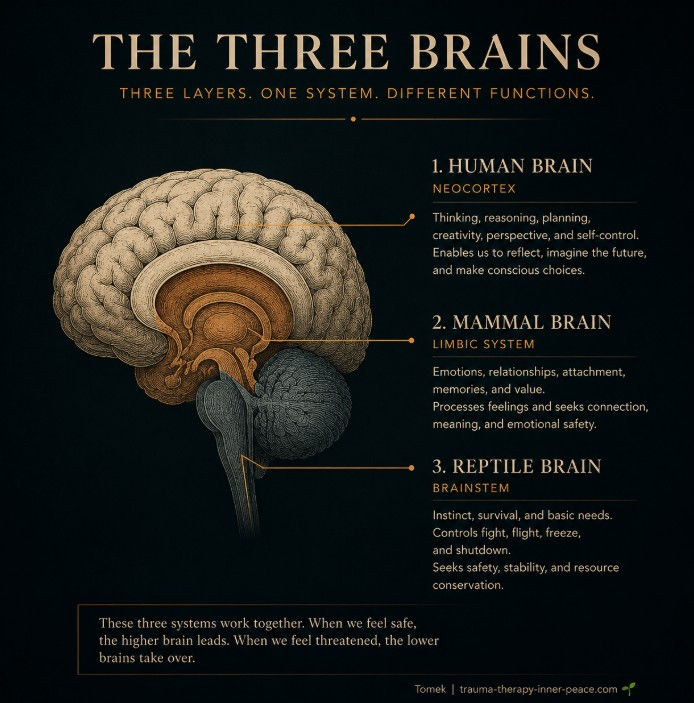
Here's what I wish someone had told me earlier. Psychosomatic doesn't mean imagined. It means the mind and the body are one system. When your nervous system stays on high alert for years, from stress, from old experiences, from emotions that never had a safe place to go, the body keeps score. It can show up as pain, skin flares, gut trouble, fatigue, or headaches.
The pain is real. The question is what keeps it running.
My road, in one picture

The first half is me living with it. Thirteen years of attacks, a diagnosis, passing out, and spreadsheets full of data that still didn't answer the question why.
The second half is where I started digging into myself. That's where everything changed.
What healing actually looked like
People always ask me for the one thing. There wasn't one. No magic supplement. No single breathing trick. Healing was a shift in where I was looking.
From the headache to the person having it. For years I studied attacks. Then I started asking different questions. What happens when the nervous system never gets the all-clear? Can old experiences keep running in the present? Where do emotions go when they never get processed? And what did any of this have to do with me?
From knowing to feeling. I read a lot about trauma and the nervous system. It helped. But knowing about something and processing it are two very different things. Therapy was where the real work happened. Not in my head. In my body.
From fighting my body to listening to it. Mindfulness taught me to notice what was happening inside me before it turned into pain. Tension. Old fear. The body bracing for danger that wasn't there anymore. Slowly, my nervous system learned that it was allowed to stand down.
From waiting for the next attack to living. This was the biggest change of all. I stopped organising my life around the next attack. I stopped seeing myself as a patient.
And my body followed.
In 2023, chronic became episodic, then occasional. In 2024, no more medications. In 2025, oxygen only rarely, at minimal flow. In 2026, attacks only in January, while I had facial shingles.
Nineteen years in. Almost none now.
I'm not saying this works the same way for everyone, or that it replaces medical treatment. I'm saying that for me, healing started the moment I was willing to look at the layer underneath the pain.
Why I wrote Cluster(ed) No More
At some point I realised that nineteen years of searching had turned into a story worth sharing.
It's for anyone whose body keeps sounding an alarm that nobody can explain. Anyone stuck in loops of anxious thoughts, unexplained pain, or a diagnosis that has quietly become their identity.
Inside, I share my own story and data, what I learned about trauma, psychosomatic illness and the nervous system, and the practices that moved me out of it. Exercises included, so you can start looking at your own patterns.
It doesn't say your pain is in your head. It says your pain might have more than one layer, and that some of those layers can heal.
If you are still searching
I'm not asking you to drop conventional medicine. If your symptoms are severe, new or unexplained, see a doctor first.
I'm asking you not to stop at the first layer. Track. Question. Learn. And when you're ready, look at what your nervous system, your history and your emotional patterns might be carrying.
That changed my life. Then it became a book.
My journey is not a prescription. It's an invitation to ask one question: what else might I be missing?
Tomek
Inner Peace


Comments