
The Three Brains: Why you think one thing, feel another, and react in a third way

Tomek Maciaszek | Inner Peace — Trauma Therapy | Gdynia & online
In short: You're not one voice making one decision. You carry three interconnected systems a thinking brain, a feeling brain, and a survival brain. And under stress, the oldest one usually wins. Understanding this doesn't fix everything overnight. But it explains why insight alone never changes behaviour, and it points toward what actually does.
Table of Contents
1. Why Does This Matter at All? {#why}
I used to hate myself for this.
I'd decide to stay calm. My chest would tighten anyway. I'd know I was safe. The anxiety would rise anyway. I'd want to say something honest and something in me would shut the door before the words got out.
Afterward, always the same question: why did I react like that?
For years I thought the answer was discipline. More willpower, more self-control. And it wasn't. The real answer is that I was never one system making one decision. None of us are.
If you've ever felt torn between what you think, what you feel, and what your body does anyway, regardless of what you decided this is worth understanding. Not as theory. As something that changes how you relate to your own reactions.
2. The Three Brains, One System {#system}
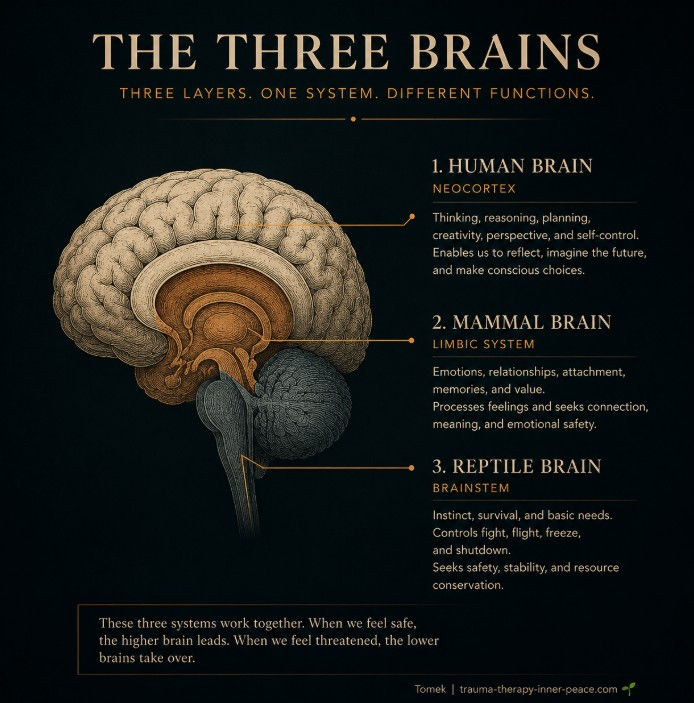
We like to imagine the mind as a single voice one "you," making decisions. It isn't. You carry three interconnected systems, layered on top of each other, each with its own job, its own speed, its own logic. This is often called the "three brains" model. It isn't a perfect scientific map of the brain, modern neuroscience is far messier and more integrated than three clean layers but as a way of understanding your own reactions, it's one of the most useful frameworks I know.
The thinker. This is the newest part of you, evolutionarily speaking. It reasons, plans, reflects, imagines consequences, and to some extent controls impulses. It's where self-awareness lives. It's the voice that says this isn't good for me or I want to respond differently. It's also, and this matters enormously, the slowest of the three. And it doesn't get the final vote.
The feeler. Underneath the thinker sits the emotional system. It doesn't use words it uses signals. Warmth. Tension. Longing. Dread. It's deeply relational, quietly asking one question underneath everything: am I safe with this person? Do I matter? Will I be rejected? It moves faster than the thinker, and it shapes your behaviour more than most of us want to admit.
The survivor. At the core is the oldest layer the one that kept your ancestors alive long before language existed. It handles breathing, heart rate, energy conservation, and threat detection. It doesn't care whether you're happy, fulfilled, or healed. It has exactly one job: keep you alive. It reacts before you think, before you even fully feel. When it senses danger (real or not) it reaches for one of four responses: fight, flight, freeze, or shutdown.
These three systems talk to each other constantly. They don't always agree. And when they don't, the older system usually wins.
3. The Hierarchy of Control {#hierarchy}
Here's the rule that changed how I understand every reaction I have: the deeper the system, the more control it takes under stress.
When you feel safe, the thinker leads. When you feel emotionally activated, the feeler takes over. When you feel genuinely threatened, the survivor takes the wheel and everyone else goes quiet.
This isn't a malfunction. It's the design working exactly as intended.
Picture this: you're about to say something vulnerable to someone who matters to you.
The thinker says: this is healthy, say it.
The feeler says: this is risky, what if they leave?
The survivor says: shut it down.
And just like that, you go quiet. Change the subject. Say something safer than what you meant. Later, the thinker comes back online, confused: why didn't I just say it?
You didn't fail. You got outvoted.
I lived inside the "shutdown" response for nineteen years, in the form of chronic pain that had a name, a diagnosis, and medication - cluster headaches. For most of that time I treated it purely as a medical problem to manage. What I didn't understand back then was that my survival brain had decided, somewhere along the way, that shutdown was the safest option available. It wasn't wrong to try to protect me. It was just running an old program in a body that had long since left the original danger behind.
4. Why Awareness Alone Doesn't Change Behaviour {#awareness}
This is where many people get stuck, myself included and for a long time.
You can read everything. Reflect on every pattern. Analyse your childhood in forensic detail. And still react exactly the same way next time.
Because insight lives in the thinker. Your patterns live in the feeler and the survivor. When a situation triggers you, the deeper systems don't wait for your insight to weigh in, they act first, and the thinker only catches up afterward.
You don't struggle to change because you lack discipline. You struggle because your system is prioritising safety over intention and it's doing that automatically, faster than thought.
There's a difference, too, between how each system learns. The thinker learns through words and ideas. The deeper systems learn through experience, especially emotional experience. If you learned early in life that vulnerability leads to rejection, that conflict leads to danger, that closeness leads to pain, your emotional and survival systems filed that away as fact. Permanently. So when a similar situation appears later, your body reacts. Not to the present. To what it learned from the past.
5. How Trauma Disrupts the Balance {#trauma}
Trauma, especially the early or repeated kind, changes how these three systems interact with each other.
The survival brain becomes more sensitive, quicker to sound the alarm, even over things that aren't actually dangerous anymore. The emotional brain becomes more reactive, or in some cases, it goes the other way and goes numb. And the thinking brain becomes less accessible exactly when you need it most, pushed offline by the other two.
The result often looks like hypervigilance, emotional overwhelm, shutdown or dissociation, difficulty making even simple decisions, and the same patterns repeating no matter how much you understand them intellectually. The system is constantly scanning for danger, even when there isn't any left to find.
This is also why healing was never, for me, primarily an intellectual process. If a pattern lives in the deeper systems, change has to reach those levels too, not just conceptually, but experientially. That means feeling different states in the body. Experiencing safety in new, repeated ways. Building new emotional associations slowly, rather than trying to reason your way past an old one. Staying present with discomfort without being swept away by it.
Change happens when your system learns, through direct experience rather than argument: this is different now. This is safe enough.
6. The Traps of Working With This Model {#traps}
A few things I see often, both in my own process and in the people I work with:
Trying to eliminate the lower brains. The goal was never to override your survival responses or "outgrow" your emotions. These systems aren't mistakes, you need the survivor to stay alive, the feeler to connect, and the thinker to reflect and choose. The goal is integration, not domination.
Using this as a way to bypass responsibility. "My survival brain took over" can become an easy excuse to avoid ever examining a pattern. Understanding why you reacted a certain way isn't the same as deciding it's now untouchable. The model explains, it doesn't excuse indefinitely.
Trying to think your way into safety. If you're in a genuinely activated state, reasoning with yourself rarely works, no matter how correct the reasoning is. The body has to be addressed before the mind can be useful again. Skipping straight to thought is one of the most common and most frustrating mistakes people make.
7. Exercise: Working With All Three Brains {#exercise}
You don't win this by fighting your own wiring. You work with it, in order. Try this the next time you notice yourself reacting more strongly than the moment calls for.
Part 1 — Regulate the body first
If your survival brain is activated, thinking won't help yet. Slow your breathing. Feel your feet on the ground. Notice three things you can see, two you can hear, one you can physically feel. This tells your system, through the body not through argument that you're not in immediate danger.
Part 2 — Acknowledge the emotion, without analysing it yet
Simply name it: I feel anxious. I feel tense. I feel afraid. Don't explain it, justify it, or fix it yet. This step engages the emotional brain without flooding it further.
Part 3 — Bring in thought, only now
Once there's some regulation, ask: what is actually happening right now? What do I need in this moment? Is this situation really the same as the past, or does it just feel that way?
Part 4 — Look for the pattern, gently
Instead of asking "why can't I just change," try: which part of me is active right now? Is this a thought, a feeling, or a survival response? What does this part of me actually need?
This won't resolve anything on the first try. But repeated often enough, it's the beginning of trading self-judgment for self-understanding and that shift, more than any single insight, is where real change quietly starts.
FAQ {#faq}
Is the "three brains" model scientifically accurate? Not in a strict anatomical sense modern neuroscience shows far more integration between brain regions than a clean three-layer split suggests. As a functional model for understanding your own reactions, though, it remains genuinely useful, which is why it's still widely used in trauma-informed work.
Can I train my thinking brain to just override the other two? Not directly, and trying usually backfires. The deeper systems respond to experience and safety signals, not argument. Working with the body and emotions first is what actually creates space for the thinking brain to stay online.
Why do I react the same way even after years of therapy or self-reflection? Because insight lives in the thinking brain, and many patterns live deeper than that. Progress often shows up first as a slightly longer pause before the old reaction, not as the reaction disappearing completely. That pause is real progress, even when it doesn't feel dramatic.
Is this connected to the window of tolerance? Closely. The window of tolerance describes the zone where all three brains can stay online together. Outside that window, the survival brain typically takes over completely. The two models describe the same territory from different angles.
Does this mean my reactions aren't really "me"? Not quite the opposite, actually. All three systems are you there isn't a "real you" hiding behind the survival response, waiting to be freed. The thinker, the feeler, and the survivor are all genuinely yours, shaped by your history and your biology. The goal isn't to find the "true self" underneath the reaction. It's to widen the space where all three parts of you get a say, instead of one taking over completely and speaking for the rest.
Your reactions aren't proof that something is wrong with you.
They're evidence that three different systems inside you are doing exactly the jobs they were built for sometimes in ways that made sense once, and don't always serve you anymore.
The work was never to silence those parts. It's to understand them, and slowly, patiently, help them trust that the present is different from the past.
I know, I've lived it!
Tomek Maciaszek — certified psychotraumatologist, CPT and PE specialist, Mindfulness practitioner. Working in Gdynia and online, in Polish and English.


Comments