
Is This Trauma? 5 Signs You Shouldn't Ignore

Tomek Maciaszek | Inner Peace — Trauma Therapy | Gdynia & Online

For a long time, I thought trauma belonged to other people. To those who had been through something truly serious. An accident. War. Violence. What happened to me that was just a difficult childhood stress and/or life.
It took me a long time to understand that trauma isn't defined by the event. It's defined by what happens in the nervous system. And that you can carry trauma from something that, from the outside, looks like nothing much at all.
This article isn't here to give you a diagnosis. It's here to help you stop ignoring the signals your body has been sending for years.
Table of Contents
1. What trauma is — and what it isn't {#what-it-is}
Let's start with what trauma is NOT.
Trauma is not weakness. Not a lack of resilience. Not the result of being too sensitive or taking things too seriously. Not something you just need to get over.
Trauma is a biological response of the nervous system to an experience that exceeded its capacity to process. Something that happened too fast, too intensely, or for too long without the possibility of escape, defence, or support from someone close.
And here's what matters most: it's not the event itself that creates trauma. It's the absence of resource in the moment the event occurs.
That's why the same experience can be traumatic for one person and not for another. Not because one is stronger. Because they had different support, different resources, a different history before it happened.
Trauma can arise from:
A single, acute event (an accident, assault, sudden loss)
Prolonged stress with no way out (an abusive relationship, a difficult childhood, chronic neglect)
Events that from the outside "don't look serious" — public humiliation, rejection, being invisible to someone important
Medical trauma — painful procedures, especially in early childhood
Complex trauma (C-PTSD) — the most common form I work with — develops from repeated, difficult experiences within relationships, usually in early childhood. There's no single dramatic moment. There are years of patterns.
2. Sign 1: You're reacting to what was — not what is {#sign-1}
Do you know this feeling?
Someone says something neutral and you feel a sudden stab of shame. Someone raises their voice and your body responds as if catastrophe is beginning. Your partner does something small and inside you a rage rises that's out of proportion to the moment. You're left alone for an evening and somehow it's darker than it should be.
This isn't oversensitivity. This is your nervous system recognising a pattern from the past and responding to it before it has time to process the present.
In neurobiology, this is called traumatic reactivation. Something in the current moment like a smell, a tone of voice, an expression, a similar situation, activates an experience stored in the nervous system. And for a moment, you are literally back there. In body, in emotion, in belief.
How to recognise this in yourself:
Pay attention to moments when your reaction is clearly out of proportion to the trigger. When you feel intense fear, shame, rage or despair and the situation doesn't objectively justify that intensity. When afterwards you think: "why did I react like that?"
That's not a question about character. That's a question about history.
3. Sign 2: Your body remembers, even when you don't {#sign-2}
Trauma doesn't live in narrative. It lives in the body.
Bessel van der Kolk wrote a book whose title is a diagnosis: "The Body Keeps the Score." And it's literally true. Traumatic experiences are stored not only as memories, but as patterns of muscle tension, as patterns of breathing, as patterns of dissociation.
That's why you may not remember the details of something that happened to you and your body is still carrying the mark of it.
Physical signals worth noticing:
Chronic tension in specific areas the neck, shoulders, jaw, chest, stomach. Shallow breathing as your default way of breathing. A sense of heaviness in the body, difficulty getting moving in the morning. Hypersensitivity to touch in certain places or certain contexts. Chronic pain without a clear medical basis headaches, back pain, stomach pain.
Chronic muscle tension, shallow breathing and psychosomatic symptoms are among the most common manifestations of unprocessed trauma. The body doesn't lie. It speaks in what we feel before the mind has had time to name it.
Important: the presence of these symptoms doesn't prove trauma. But their presence combined with other signals is worth taking seriously.
4. Sign 3: It's hard to feel safe when things are safe {#sign-3}
This is one of the most paradoxical and least understood symptoms.
It's not that you seek danger. It's that calm, closeness, safety trigger anxiety. That when nothing bad is happening, you wait for something to. That the warmth of another person is pleasant, but something in you withdraws. That you don't know how to sit with nothing.
The nervous system learns from what it experiences. If for years safety was unpredictable or preceded difficult events the nervous system begins to treat it as a warning signal, not a reward.
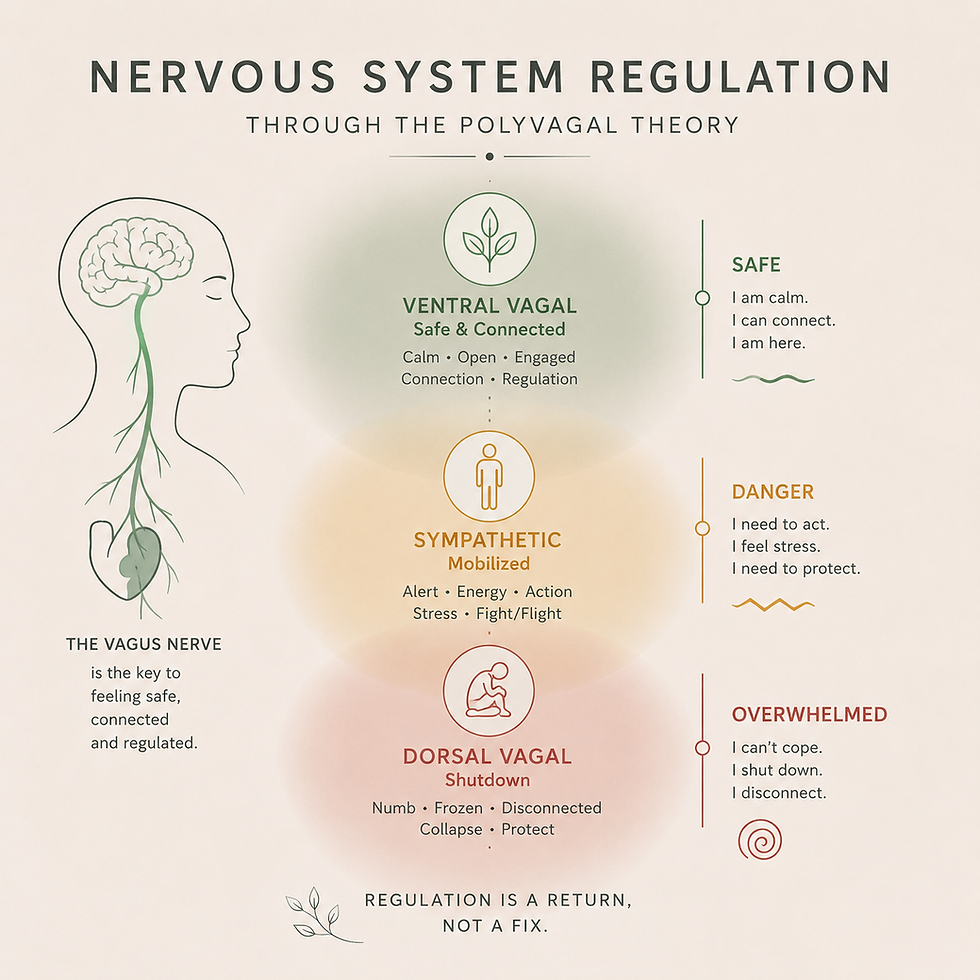
Stephen Porges described this as neuroception the automatic, subconscious scanning of the environment for threat signals. In a person with trauma, this scanner is recalibrated. It sees danger where there is none. It doesn't register safety, even when it's present.
What this looks like in practice:
Sabotaging good things like relationships, professional situations, moments of peace. Inability to rest without guilt or anxiety. Constant vigilance and difficulty "switching off." A sense that when things are good, you need to be careful, because it won't last.
This isn't a pessimistic character. This is a biological adaptation.
5. Sign 4: Your relationships follow a repeating pattern {#sign-4}
Have you ever noticed that you end up in similar relational situations? That certain types of people, certain dynamics come back, even though each time you tell yourself this time will be different?
Relational trauma particularly from early childhood programmes attachment patterns. It teaches us what to expect from others, how to behave in order to survive, what we do with pain in a relationship.
And these patterns, unconscious, repeat. Not because we want to suffer. Because they're familiar. And familiar even when it hurts is safer for the nervous system than the unknown.
Patterns worth noticing:
Chronic giving without receiving, combined with an inability to ask for what you need. A strong fear of abandonment or rejection that drives relational decisions. Difficulty with closeness despite longing for it. Entering relationships with people who need "fixing." A tendency to lose yourself in a relationship your own needs, boundaries and opinions become secondary.
Not every one of these patterns means trauma. But several at once, particularly when they have a long history are a signal worth exploring.
6. Sign 5: You feel like something is fundamentally wrong with you {#sign-5}
This is the most painful and the most common sign of complex trauma.
It's not that you think you have a bad character. It's a deeper, often hard to verbalise belief: that you are flawed. That other people are different they can feel calm, joy, belonging and you can't, because something in you doesn't work the way it should.
This belief is not true. But it's remarkably resistant to logic. Because it didn't form through words it formed through experience. Through being unseen, unaccepted, shamed, rejected by people who were supposed to be safe.
A small person who experiences something difficult at the hands of someone important to them has two explanations to choose from: either something is wrong with that person (but that's impossible, because my survival depends on them), or something is wrong with me. Children always choose the second. And they carry that belief into adulthood.
How this shows up:
Chronic shame is not about specific actions, but about simply being. A deep sense of being "too much" or "not enough." A belief that if someone truly knew you, they would leave. An inability to receive compliments or positive feedback without immediately questioning it. A sense that good things have to be earned and earning them is almost impossible.
7. What to do with this {#what-to-do}
Recognising the signals is the first and most important step. Not because recognition alone heals but because it interrupts the automatic pattern.
Instead of "why do I keep reacting like this?" comes "ah, this is a pattern." Instead of shame, curiosity. Instead of fighting yourself, interest in what your nervous system is trying to protect you from.
What helps:
Body-based work, somatic therapy, EMDR, SE (Somatic Experiencing) addresses trauma at the level where it actually lives: in the nervous system and the body, not just in narrative. Talk therapy alone, though helpful, often isn't enough.
Nervous system regulation, daily practices that gradually widen the window of tolerance and build a new calibration of safety. I wrote about this in detail in the article on [nervous system regulation].
Safe relationship with a therapist, with a close person, with a community. Co-regulation through contact with another person's regulated nervous system is one of the most powerful healing factors.
And time. Trauma built over years doesn't disappear in weeks. But each session, each moment of awareness, each experience of safety genuinely changes something.
8. FAQ {#faq}
Do I need to remember a specific event to have trauma? No. Complex trauma often has no single clear moment it's the sum of many, repeated experiences. You can carry trauma without any "dramatic" memory.
Does trauma always require therapy? Not always but therapy often significantly accelerates and deepens change. Complex trauma (C-PTSD) in particular is difficult to work through alone, because it involves patterns that are invisible from the inside.
What's the difference between PTSD and C-PTSD? PTSD is usually linked to a single traumatic event and centres on flashbacks, avoidance and hyperreactivity. C-PTSD (complex trauma) develops from prolonged, repeated experiences often within relationships and additionally involves identity disturbance, chronic shame, relational difficulties and emotional dysregulation.
Can you have trauma from a "good" home? Yes. Emotional neglect invisibility, lack of warm contact, emotional unavailability of a parent can be just as traumatising as active harm. You don't need a reason for trauma that's "big enough" in other people's eyes.
How long does trauma therapy take? This is very individual. Working with a single traumatic event can take a few to a dozen sessions. Complex trauma months to several years of regular work. More important than time is whether you feel you're moving in the right direction.
Final words
If you recognise yourself in this article, not in one place, but in several that's not a coincidence.
This is not weakness. This is not a bad character. This is a history stored in the nervous system, still trying to protect you in the way it learned long ago.
And that history can be changed. Not erased but changed. The nervous system is plastic. Patterns built over years can gradually be reshaped through new experiences, new relationships, new self-knowledge.
I know this path. I walked it myself.
If you want to understand where to begin — reach out. The first conversation is free.
Tomek Maciaszek — certified psychotraumatologist and mindfulness practitioner. I work with adults in the process of recovering from trauma, stress and burnout. Gdynia & online.
Comments