
Nervous System Regulation: The complete guide — Why your body reacts before you have time to think

Tomek Maciaszek | Inner Peace — Trauma Therapy | Gdynia & online
For many years I didn't know that what I was experiencing had a name and an explanation.
Reactions that surprised me. States that arrived without clear cause. A body that worked differently from how I wanted. Thinking that could completely shut down at the wrong moment.
I thought something was wrong with me.
And then I discovered it wasn't. It was a nervous system doing exactly what it had learned to do.
Table of Contents
1. What nervous system regulation is {#what-is}
You walk into a room and something — you don't know what — makes you feel uneasy. Your heart quickens. Muscles tighten. Breath becomes shallow. And you think: why am I reacting like this? It's safe here.
Or you're in an important meeting, you have something to say — and suddenly there's nothing. Your body freezes. Thoughts cut off. Your voice won't come.
Or someone says something innocent — and you react with anger that surprises even you. The proportion is wrong. You know it. But you can't stop it.
These aren't character weaknesses. This is a nervous system responding to patterns it learned in the past.
Nervous system regulation is the ability to return to balance — after an emotion, after a difficult situation, after stress. It's not a state of permanent calm. It's elasticity. The ability to move out of arousal and return to centre.
People with good regulation respond to situations rather than just reflexively reacting. They come out of difficult emotional states without hours of recovering. They have access to clear thinking even under stress. They feel grounded in the body and in the present moment.
Regulation is not an innate trait. It's a skill. And like any skill — it can be trained.
2. The three states of the nervous system {#three-states}
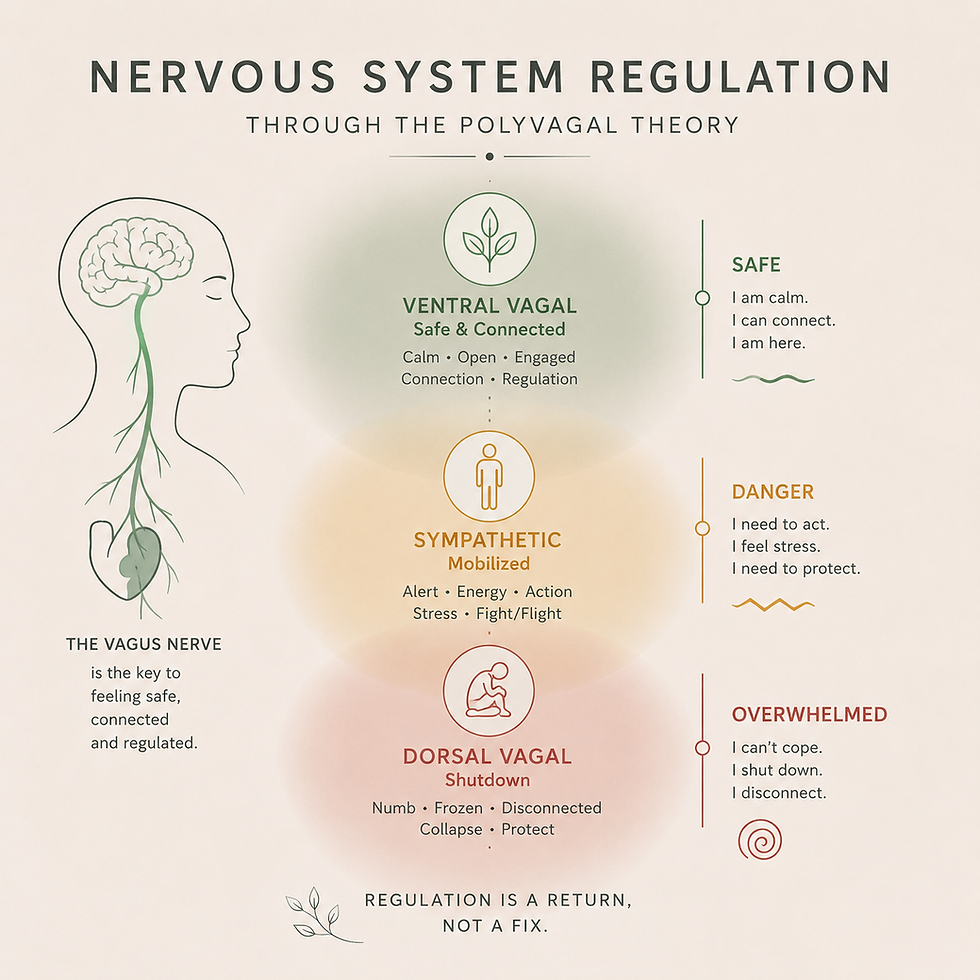
Stephen Porges — one of the most important neurobiologists of recent decades — described three fundamental states of the autonomic nervous system in his Polyvagal Theory. Understanding them changed how I look at my own reactions.
State 1 — Safe Engagement
This is the state of optimal functioning. Breathing calm and deep. Heart rate slow and regular. Facial muscles relaxed. Eye contact and authentic presence with others is possible. Thinking clear. Emotions — including difficult ones — are accessible without being flooded by them.
This is the state in which therapy, learning, deep conversation, creativity, and love are possible. Most of us spend too little time here.
State 2 — Mobilisation
Activates when the brain assesses that a threat requires action. Fight or flight.
Heart rate accelerates, breathing shallow and fast. Blood moves away from extremities to large muscle groups. Digestion suspends. Vision narrows — you literally see less. Thinking becomes black-and-white. Fear, anger, anxiety dominate.
This state is essential — without it we wouldn't survive threats. The problem arises when it's chronically activated by situations that objectively pose no danger.
State 3 — Freeze
The oldest evolutionary state. Activates when the threat is assessed as overwhelming and neither fight nor flight is possible.
Heart rate and breathing slow. The body becomes heavy. Dissociation appears — a sense of detachment from oneself. Emotions become inaccessible. Thinking is slow, foggy. Words don't come.
For many people after trauma, this state is the default — the body learned that the best protection is to disappear.
3. How to recognise which state you're in {#recognition}
You can't change what you can't see. Awareness of your own state is the first regulation skill.
When you're in activation: Muscle tension — particularly neck, shoulders, jaw, hands. Shallow, fast breathing or breath-holding. Quickened heartbeat. Thoughts jumping, difficulty focusing. Irritability. A sense of urgency without clear cause. You hear words but they don't land.
When you're in freeze: Body heaviness, difficulty moving. Emotional emptiness — I feel nothing. Foggy thinking. A sense of detachment from yourself. Lack of energy despite sleep. Difficulty speaking or expressing needs.
When you're regulated: Breathing natural, effortless. Eye contact is possible. You can hear voices in a noisy environment — this is a biological marker of safety. Curiosity and humour are available. The body is present but not tense.
4. Why regulation is hard after trauma {#trauma}
Trauma changes how the nervous system calibrates safety.
In an environment where safety was unpredictable or absent, the nervous system learns one thing: the world is dangerous, stay ready. This learning happens deep, below awareness, recorded biologically in brain structures.
The result is that the nervous system of a person after trauma may have a very narrow window of tolerance — a small stimulus is enough to leave the regulated state. It may misinterpret safe signals as threat — a warm voice, close contact, calm in a relationship can be alarming to a nervous system that learned calm is suspicious. It may not know how to return to centre after activation. It may get stuck in freeze as the default.
This is not the fault of the person after trauma. It is a biological adaptation to conditions that were. And — like any adaptation — it can be changed.
5. The window of tolerance {#window}
A term introduced by psychiatrist Daniel Siegel, popularised by Pat Ogden.
The window of tolerance is the range of arousal within which optimal functioning is possible — processing emotions, clear thinking, authentic contact with others.
Think of a thermometer. Too hot — hyperarousal, stress, anxiety, anger, panic. The optimum — window of tolerance, presence, flexibility. Too cold — hypoarousal, numbness, freeze, emptiness.
In a person with a healthy nervous system, the window is wide. They can experience intense emotions and remain within it. They return to centre relatively quickly.
In a person after trauma, the window is often very narrow. Small stimuli are enough to fall out of it upward or downward. Return is difficult and slow.
The goal of regulation is expanding this window. Not eliminating difficult emotions — but increasing the capacity to be with them without leaving the centre.
6. Regulation techniques {#techniques}
Different techniques work at different time levels. You need different ones when you're in the middle of a crisis, different ones for daily hygiene, still others build long-term elasticity.
When you're outside the window of tolerance
Physiological sigh. A double inhale through the nose — a short inhale immediately followed by a second to fully inflate the lungs — then a long, slow exhale through the mouth. Activates the parasympathetic nervous system immediately. Researched by Andrew Huberman at Stanford.
Orienting in space. When the nervous system loses contact with the present — slowly, consciously looking around, noticing specific objects, colours, shapes. Activates the brain's safety assessment system. Here and now is safe.
Cold water on face or wrists. Activates the diving reflex — an evolutionary mechanism that rapidly slows heart rate. Particularly effective with strong arousal.
5-4-3-2-1. 5 things you can see, 4 you can hear, 3 you can touch, 2 smells, 1 taste. Moves attention from internal alarm to external reality.
Movement. Stress mobilises energy for action. When you can't discharge it through actual action — movement processes it. A few jumps, vigorous shaking of the hands, a fast walk. This isn't a metaphor. It's physiology.
Daily nervous system hygiene
Diaphragmatic breathing. 10-15 minutes daily of slow, deep belly breathing. Exhale longer than inhale — inhale 4 seconds, exhale 6-8. Every long exhale activates the vagus nerve.
Cold shower. Brief cold exposure — 30-90 seconds of cool water — trains the nervous system. Exercises the capacity to tolerate discomfort and quickly return to regulation.
Rhythmic movement. Walking, running, swimming, dancing. Bilateral movement — alternating left-right sides of the body — is an element of EMDR therapy for a reason. It has a direct regulatory effect.
Humming or singing. Sounds trivial but has solid neurobiological foundations. The vagus nerve innervates the vocal cords and larynx. Sound vibrations during humming directly stimulate it. Hence the intuitive rocking and humming of infants — regulation through sound.
Sleep. The most important and most frequently overlooked. Sleep deprivation increases amygdala reactivity by 60% (Matthew Walker). Regulation is impossible on chronic sleep deprivation.
7. Regulation through the body {#through-body}
The nervous system is a whole-body system — not just the brain. The body is both a receiver of nervous system states and an entry point through which we can influence them.
Body posture. A hunched, collapsed posture signals threat. An upright spine, open chest — safety. This works both ways. Changing posture changes the internal state.
Safe touch. Activates the vagus nerve and releases oxytocin — the bonding and safety hormone. Self-massage of the face, neck, shoulders. A weighted blanket. Hugging. All have a physiological regulatory effect.
Yoga and somatic work. Yoga — particularly breath- and body-awareness focused styles like Yin or Restorative — is one of the most thoroughly researched methods of nervous system regulation in trauma. Not because of stretching. Because it combines movement with breath with attention in a way that directly addresses the somatic patterns of trauma.
Grounding. Conscious contact of feet with the ground. Walking barefoot on grass. Sitting with your back against a wall. Anything that gives a physical sense of "I am here, I have support, I am safe."
8. Regulation through relationships {#through-relationships}
Porges demonstrated something fundamental: the human nervous system regulates itself primarily through relationship with other people.
This isn't a poetic observation. It's neurobiology.
Your nervous system continuously scans the environment for signals of safety — and does this primarily by observing the faces, voices, and body posture of others. This process — neuroception — happens below awareness.
A calm, warm voice regulates the nervous system. A soft, interested gaze regulates the nervous system. The physical presence of a safe person regulates the nervous system.
And in reverse — a tense face, a sharp voice, an abrupt movement dysregulates.
Co-regulation — regulation through contact with another person's regulated nervous system — is probably the most powerful form of regulation. This is why an infant calms in the arms of a calm caregiver. This is why a safe therapeutic relationship is itself healing.
Practical implications: choose your environment. Chronically spending time with people in states of dysregulation dysregulates your nervous system — even if you're not discussing anything difficult. Seek co-regulation consciously. Limit what consistently takes you outside your window of tolerance.
9. Building long-term regulation {#long-term}
Regulation is not a one-time technique. It's a gradual change in the baseline calibration of the nervous system.
In the first weeks you learn to recognise your own states. That is already a change — awareness replaces automatism.
In the first months regulatory techniques begin working faster. The window between stimulus and response widens.
After a year of regular work changes in nervous system structure are measurable. Heart rate variability increases. Amygdala reactivity decreases. The window of tolerance is noticeably wider.
What accelerates this process: regularity over intensity — 10 minutes daily is worth more than 2 hours once a week. Body work — cognitive techniques alone work more slowly than combining body and mind work. Safe relationship — therapy, support, community — relational co-regulation accelerates changes. And gradualness — regulation built slowly is more lasting.
10. FAQ {#faq}
How does regulation differ from relaxation? Relaxation is passive reduction of arousal — lying down, watching a series, napping. Regulation is active work with the physiological mechanisms that manage arousal states. Relaxation can be helpful — but doesn't build the capacity to flexibly move between states.
Does regulation replace therapy? No — it complements it. It's hard to process trauma when the nervous system is in strong dysregulation. But regulation alone won't process traumatic experiences or change deeply rooted beliefs.
How long does learning regulation take? First effects — recognising states, basic techniques working — appear within a few weeks. Lasting change in baseline calibration takes months to years.
Is HRV a good indicator of regulation? Yes. Heart rate variability is one of the best measurable indicators of nervous system health. Higher HRV correlates with greater elasticity, better emotional regulation, and physical health. Smartwatches measure HRV — worth monitoring.
What is the vagus nerve and why does it matter? The longest cranial nerve — connects the brain to the heart, lungs, intestines, and other organs. Manages the parasympathetic system. 80% of its fibres transmit information from the body to the brain — not the other way around. That's why the state of the gut, heart, and lungs literally affects emotional state.
Can sport alone train the nervous system? Partially. Rhythmic sport — running, swimming — regulates the nervous system by discharging mobilisation energy. But running alone doesn't address traumatic patterns or somatic tension patterns rooted deeply in the nervous system.
Closing
The nervous system is not our enemy. It is a system designed to protect life — and it does this as well as it can, using the information it has. When that information comes from a past that was difficult — the system reacts as if that past is still happening.
Regulation is not fixing something broken. It is teaching the system that things are different now. That it's possible to be safe. That constant vigilance is no longer necessary.
That learning takes time. It takes patience. And often — the support of someone who knows this path.
But it's possible. And it changes everything.


Comments