
The Window of Tolerance. Why You Sometimes Feel Too Much. And Why Sometimes You Feel Nothing At All

For years, I thought something was wrong with me.
I remember nights when the pain was so intense I lay on the floor counting minutes. Cluster headaches. Nineteen years. And somewhere in the back of my mind, a thought kept smouldering: maybe this is my fault. Maybe I'm too sensitive. Maybe I'm just weak.
But there was another kind of suffering, quieter, less obvious. One moment I was at the edge of explosion for no clear reason. Heart racing, thoughts spiralling, body tight as a wire. The next moment, nothing. I'd sit and stare at the wall, feeling hollow. Like I was watching my own life from behind glass. Like I was a spectator of something I was supposed to be living.
For years I interpreted this as weakness, oversensitivity, or lack of discipline. It wasn't until I began to understand how the nervous system actually works -- and how deeply suffering marks it -- that something shifted. Not because I found a magic solution. But because, for the first time, I understood what was really happening.
That's what I want to show you today.

What is the Window of Tolerance?
The concept was introduced by Dr. Dan Siegel neuropsychiatrist, researcher, and one of the pioneers of interpersonal neurobiology. Siegel defines it as the optimal zone of arousal in which we can function effectively, learn, and remain in connection with others.
But you don't need the academic definition to feel it in your own body.
The window of tolerance is the zone in which your nervous system feels safe enough. Not perfectly calm. Not emotionless. Not in a state of permanent harmony. Just stable enough to be here, now.
When you're inside your window:
• You think clearly, even under pressure
• Emotions are present, but they don't overwhelm you
• You can listen, respond, and problem-solve
• You feel connected -- to yourself and to others
• You can feel difficult emotions -- and return from them
This is not a state of bliss. It's not the calm before a storm. It's simply your centre the place from which you can live, love, and be yourself.
And it's a state you can return to. Even if it has felt out of reach for a long time.
What Happens When You Fall Outside?
The nervous system has two primary emergency modes. Most of us know both of them, we just haven't always had names for them.
Hyperarousal - too much
You know the feeling when your heart races for no clear reason? When you argue over something that seemed enormous in the moment but trivial in retrospect? When thoughts are racing and you can't slow them down, can't sleep, can't simply be?
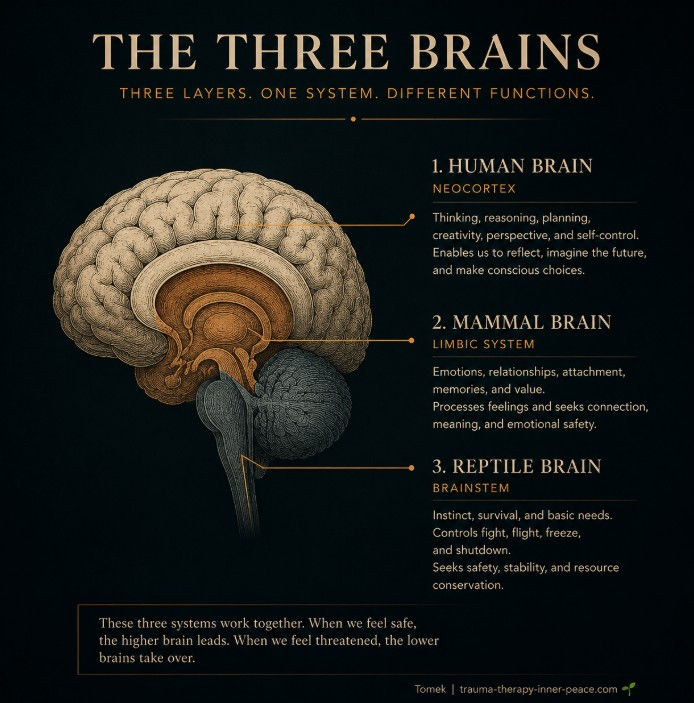
That's hyperarousal. Fight or flight. The amygdala, the part of the brain responsible for detecting threat, has fired the alarm. And now your entire body is mobilised for action.
The problem is that this alarm often fires when there's no real threat. An old pattern. Learned vigilance. A long-remembered danger that the nervous system still treats as current. Your body is responding to the past as though it were the present.
On the outside, you might look completely normal. But inside, there's a state of combat readiness running at full capacity.
Hypoarousal - too little
And then there's the other mode. You might know this one just as well or even better.
Emptiness. Numbness. The sense of watching your life from outside. Hard to get up, hard to feel, hard to want anything. Not sad in a classical sense, just absent. Someone is talking to you and you hear the words, but they don't land.
That's hypoarousal. The freeze response. The oldest evolutionary answer to threat is playing dead. The nervous system decided that mobilisation wasn't working anymore so it shut down. It protects you by cutting you off from what's overwhelming.
Stephen Porges, who developed the Polyvagal Theory, describes this as activation of the dorsal branch of the vagus nerve the oldest protective mechanism of our species. This is not a choice. It is not laziness. It is physiology.
Both states share one thing: your nervous system is trying to protect you. It's doing the best it can with the tools it has. Tools that may once have kept you alive.
Why Trauma Narrows the Window
If you've experienced trauma in your life, not necessarily one dramatic event, but perhaps chronic childhood stress, emotional neglect, instability at home, years of physical pain, your window of tolerance is most likely narrower than average.
That's not a flaw. That's not weakness. That's consequence.
Your nervous system learned that the world is unpredictable. That peace is temporary. That it's safer to stay on alert. And so over years, over decades it set the sensitivity threshold very high.
In my case, it was 19 years of pain. Cluster headaches are among the most intense pains known to medicine. My nervous system literally spent two decades learning that suffering arrives without warning. That safety is an illusion. That vigilance is survival.
And even when the pain finally stopped, the nervous system didn't yet know it was over.
That's why it responds faster. Why returning to balance feels harder. Why what others experience as a minor irritation can feel unbearable to you.
You are not too sensitive. Your nervous system is doing exactly what it was trained to do, by life, by pain, by years of learning.
"What is wrong with me?" Replace it with: "What is my nervous system trying to protect me from?"
That's not a word game. That's a fundamental shift in perspective. And that's where healing begins.
The Goal is Not Constant Calm
This is where many mistakes are made, in pop psychology and in naive understandings of mindfulness alike.
The goal is not to always be calm. The goal is not to stop feeling. The goal is not positive thinking plastered over genuine dysregulation. The goal is not meditation as escape.
The goal is flexibility. The capacity to notice when you're leaving your window and the capacity to gradually return. The capacity to be with what is difficult without falling apart.
This is precisely what grows in therapy. What grows in mindfulness practice. What grows every time instead of reacting you pause for a fraction of a second and ask: what am I feeling in my body right now?
The aim is not to eliminate difficult emotions. The aim is to increase your capacity to experience them.
This distinction matters enormously. Many people who come to therapy say: I want to stop getting angry. I want to stop being afraid. I understand that impulse. But it's not achievable and it's not the point. What is achievable: I want to be able to feel fear without being governed by it.
How to Recognise Your Own Window
Everyone's window is different. Its width, its edges, its signals these are as individual as a fingerprint. There's no one-size-fits-all answer.
Start with these questions:
• What does 'okay' feel like in my body? What does that mean physically: breath, muscle tension, body temperature?
• What are my earliest signs of overwhelm? What do I feel before I explode or shut down?
• What does freeze look like for me? How does it feel?
• When did I last feel safe enough? What was around me?
This isn't a philosophical exercise. It's neurological observation. Because before you can learn to return to the window, you need to know where the window is.
Awareness is the first step. You don't need to change anything yet. The act of seeing is already regulation.
What to Do When You Fall Outside
Different states require different tools. What helps with hyperarousal can worsen hypoarousal and vice versa. That's why the first step is identifying where you are.
When you're hyperaroused - calm the activation
Here the goal is activating the parasympathetic nervous system- specifically the vagus nerve, which is the main brake of our nervous system.
• Slow, extended exhale (longer than the inhale - this is the key, because it's the exhale that activates the vagus nerve)
• Feel your feet on the floor. Literally press down. The ground is there.
• Orienting - look slowly around the room, naming what you see. This tells the brain: there is no threat here.
• Slow walking, gentle stretching, rocking
• Cool water on your wrists or face - activates the dive reflex, slowing your heart rate
None of these tools are magic. But each one tells the nervous system something important: you are here. This is the present. You can come back.
When you're hypoaroused - wake the system up
Here the goal is gentle activation - enough to move out of freeze, but not so forceful that you tip into hyperarousal.
• Cold water on your face or wrists
• Fast, rhythmic music - something you like, something you associate with energy
• Light physical movement - even a few squats or jumping in place
• Contact with a safe person - their voice, their touch, their presence
• Speaking out loud - the sound of your own voice can activate the system
Important: don't try to think your way out of hypoarousal. Thinking doesn't help here - because the parts of the brain responsible for thinking are literally less active in this state. You need the body, not the mind.
Safety Before Feeling
Many people who come to therapy have heard somewhere that you need to feel it to heal it. And that's true but it's not the whole truth.
For many people with a history of trauma, reaching for deep emotion too quickly leads to being overwhelmed all over again. This is called retraumatisation. And it doesn't help, in fact, it can reinforce the brain's belief that emotions are dangerous.
The real work is titration. Small, manageable steps. Building safety in the body before reaching deeper.
Titration is a term borrowed from chemistry - it means adding a substance drop by drop to avoid a violent reaction. In trauma therapy, it means: we touch difficult material, but briefly enough, and safely enough, that the nervous system can process it rather than collapse again.
My body was ill for 19 years. Clusters. Nights I'd rather not remember. Days when the only task was to survive. And for a long time I believed the path to health ran through willpower and overriding my body's signals.
I was wrong.
The path ran through returning to the body. Through building the capacity to tolerate what I was feeling - step by step. Through learning that I could be with what was difficult - and come back from it. That the body is not the enemy. That the signals it sends are information - not a verdict.
This didn't happen overnight. But it happened.
The Window Expands
If there's one sentence I want you to take from this article, it's this:
Your window of tolerance is not fixed. It can grow.
Growth is possible because the brain is neuroplastic - it changes through experience, for your entire life. Every time you move from dysregulation back to balance, your brain learns. Literally - new neural connections form. Old patterns can weaken.
The window grows through:
• Safe relationships - where you can be yourself without consequence. The therapeutic relationship is often the first place where this happens.
• Mindfulness practice - which teaches you to observe rather than react. Which increases the space between stimulus and response.
• Therapy and supported experience - which recalibrates the nervous system, drop by drop
• Every moment of returning to balance - because each one is evidence for the body: I felt that, and I came back
• Movement, breath, contact with nature - which activate the parasympathetic nervous system regularly, not just in crisis
This isn't theory. It's neuroplasticity. And it works.
I won't pretend it's easy. Or fast. My path took years. But it started with one moment - when instead of asking what is wrong with me, I asked: what is my nervous system trying to tell me?
What You Can Do Today
You don't need to dive straight into full therapeutic work. You don't need to understand everything at once. Start small.
Today, after reading this article try one thing:
Stop. Place your hands on your knees. Take three slow breaths (with the exhale longer than the inhale). And ask your body: where am I right now? Inside the window, above it, below it?
Don't judge. Just notice.
That one question (when asked regularly) can change your relationship with your own nervous system. Because when you begin to see what is happening, you stop being what is happening.
If this article moved something in you, feel free to reach out. I work with people whose experience resonates with what I've described here -- both in individual therapeutic work and through the materials on this site. You're here for a reason.
When Self-Work Isn't Enough
I want to be honest with you about one thing.
The tools I described above breath, grounding, orienting, movement are real and useful. I use them myself, I recommend them to my clients, I return to them in difficult moments.
But there are situations where self-work alone is not enough. When the window of tolerance is very narrow so narrow that every attempt to approach difficult material ends in overwhelm what's needed is the support of someone who can regulate your nervous system with theirs. Because regulation, in the beginning, happens in relationship. Not in isolation.
Porges' Polyvagal Theory describes what is called co-regulation: when two nervous systems are in contact, the more stable one has the capacity to regulate the less stable one. This is why the presence of a safe person a therapist, a partner, a friend can change the state of your body faster than any technique performed alone.
The therapeutic relationship is not just a conversation. It is a regulated experience. It is a place where the nervous system learns again that contact is safe. That I can show what I feel and not be punished for it. That I can be seen and survive.
If you recognise your own experience in what I've written if you've spent a long time living above or below your window, if emotions feel uncontrollable or absent it may be worth considering that step. Not because something is wrong with you. But because you deserve to live more widely.
Tomek | trauma-therapy-inner-peace.com


Comments