
Childhood Trauma: Effects in adult life and the Path to Healing

Updated: May 26

Tomek Maciaszek | Inner Peace — Trauma Therapy | Gdynia & online
Childhood trauma doesn't announce itself with a name tag. It doesn't always show up as a memory you can point to and say — that, that was the moment. More often, it arrives quietly: in the way you flinch when someone raises their voice, in the relationships that keep going wrong in the same way, in the gnawing feeling that no matter what you achieve, you still don't quite believe you deserve it.
I've sat with many people who came to therapy convinced that their childhood "wasn't that bad." And many of them were right — nothing catastrophic had happened. And yet something had happened. Something quiet. Something that left a mark.
This article is for anyone who suspects that the past might still be shaping the present.
Table of Contents
1. What Childhood Trauma Actually Is {#what-is}
Most people think trauma means something dramatic. War. Violence. Disaster. Something undeniable.
But in my work, I've found that the most common traumas are far less visible. A mother who was physically there but emotionally absent. A father whose mood you could never predict. A home where feelings weren't spoken about — or worse, were punished. A childhood in which you learned, quietly and early, that your needs were too much, that love had to be earned, that safety wasn't guaranteed.
Childhood trauma is any experience that overwhelmed a child's capacity to cope — and that wasn't processed, understood, and resolved.
A child doesn't yet have the tools an adult has. They can't step back and say "this situation is difficult but temporary." They feel it with their whole body and soul. And when there's no safe adult to help them make sense of it, the experience doesn't get integrated — it gets stored. Somewhere the body keeps it, long after the mind has moved on.
Trauma can take many forms:
Physical, emotional, or sexual violence
Emotional neglect — needs that were consistently unmet
Growing up with a parent struggling with addiction
Chronic instability or lack of safety at home
Loss — through death, divorce, separation
Rejection, mockery, or persistent criticism
Witnessing violence between adults
Serious illness, accidents, or hospitalisation in childhood
Bullying
And quieter things too — a parent who was never really present, warmth that was always just out of reach, a home where love felt conditional
The trauma is not defined by the event. It's defined by what happened inside the child who experienced it.
2. How Trauma Forms — What happens inside {#how-forms}
When a child encounters something overwhelming, the nervous system does exactly what it's designed to do — it activates survival mode. Fight, flight, or freeze. Under normal circumstances, when the threat passes and a safe adult steps in, the nervous system returns to balance. The experience gets processed. Life continues.
But when the threat doesn't pass — when it repeats, when the child has no one to turn to, when emotions are suppressed or punished — the nervous system learns something different. It learns to stay ready. Or it learns to go numb. Both were adaptations. Both were ways of surviving the unsurvivable.
The Role of Attachment
John Bowlby spent decades studying something that might seem obvious but wasn't always taken seriously: a child's need for secure attachment to a caregiver is biological. It's as fundamental as food and sleep.
When that attachment isn't secure — when the caregiver is unreliable, frightening, or is the very source of pain — the child adapts. They develop what we call insecure attachment patterns: anxious, avoidant, or disorganised. These patterns don't stay in childhood. They travel with us into every significant relationship we have as adults. Not because we choose to repeat the past, but because the nervous system only knows what it learned.
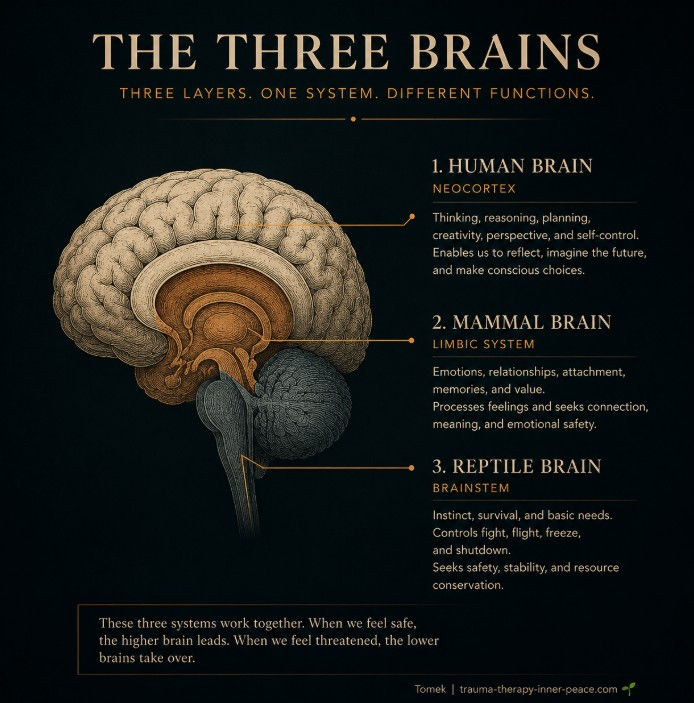
What Happens in the Brain
This isn't metaphor. Chronic stress in early childhood literally changes the developing brain:
The hippocampus — responsible for memory and processing experience — can shrink in volume
The amygdala — the brain's alarm centre — becomes hyperreactive, firing intensely at small threats
The prefrontal cortex — which governs emotional regulation, decision-making, and impulse control — develops fewer connections
These are anatomical changes. And they have real, lasting consequences for how a person moves through the world.
3. What the research tells us {#science}
The ACE Study
In the 1990s, physicians Vincent Felitti and Robert Anda conducted one of the most significant epidemiological studies in psychiatry — the Adverse Childhood Experiences study. Over 17,000 adults. Ten categories of adverse childhood experiences.
What they found changed the field:
64% of participants had experienced at least one adverse childhood experience
Those with four or more ACEs faced a fourfold greater risk of depression and a twelvefold greater risk of alcohol dependence
High ACE scores correlated with heart disease, cancer, diabetes, and shortened life expectancy
The conclusion was unambiguous: childhood has long-term, measurable biological consequences. This has nothing to do with weakness or willpower. It's physiology.
The Body Keeps the Score
Psychiatrist Bessel van der Kolk showed us something that I return to again and again in my work: trauma is recorded not only in what we remember and can put into words — it lives in the body. In the nervous system. In physiological responses that happen before thought even begins.
This is why a particular smell, a tone of voice, a certain gesture can trigger an intense stress response in a person — long after any logical danger has passed. The body remembers, even when the mind has forgotten.
And Yet the Brain Changes
Here is what I find most important, and what I want every person who comes to me to understand: the brain is plastic throughout life. Trauma changes the brain — but healing experiences change it back. New neural pathways can be built. Therapy, safe relationships, nervous system regulation — these aren't soft consolations. They are neuroscience.
4. How it shows up in adult life {#effects}
The beliefs we form about ourselves and the world in childhood don't stay in childhood. They become the operating system beneath everything we do — often without us knowing it.
In Relationships
This is where I see it most clearly in the people I work with. The patterns are strikingly consistent:
A fear of abandonment that activates even in stable, loving relationships
An alternation between clinging tightly and pushing people away
A tendency to lose yourself in relationships — to disappear into the other person's needs
Chronic difficulty with trust
The same kinds of partners, the same kinds of conflicts, over and over
People ask themselves why they keep ending up in the same situations. The answer isn't fate. It's familiarity. The nervous system moves toward what it recognises — even when what it recognises is painful.
With Emotions
The nervous system of someone with a trauma history can behave like an alarm system calibrated too sensitively. Small things trigger large responses. And that's bewildering and often shameful, on top of everything else.
People describe:
Anger that arrives too fast and too hard for the situation
Anxiety in circumstances that are objectively safe
A chronic feeling of being about to be overwhelmed
Numbness — a kind of grey absence where feeling should be
Difficulty knowing what they're even feeling (there's a word for this: alexithymia)
In How You See Yourself
A child in pain cannot see the situation clearly. A child cannot think: "My parent is struggling and this is their limitation." A child thinks: I'm the problem. Something is wrong with me. I'm not enough.
Those conclusions, formed at five or seven or nine years old, can run quietly beneath the surface of an entire adult life. They show up as an inner critic that never goes quiet. As difficulty receiving a compliment. As the bone-deep sense that love has to be earned.
Researcher Brené Brown has spent years studying shame — that particular conviction of being fundamentally broken or insufficient — and has shown how central it is to the experience of trauma. And how much it blocks healing.
In the Body
The body, as van der Kolk reminds us, keeps the score. Long-term stress from trauma doesn't stay in the mind:
Chronic tension in the neck, shoulders, and jaw
Sleep problems — difficulty falling asleep, waking repeatedly, nightmares
Persistent fatigue that rest doesn't fix
Headaches, digestive problems, chronic pain without clear organic cause
Greater susceptibility to infection, autoimmune conditions, cardiovascular disease over time
These are not imagined symptoms. They are the physiological legacy of a nervous system that spent years operating in survival mode.
In Concentration and Memory
The hippocampus and prefrontal cortex — both affected by early chronic stress — govern memory, attention, and decision-making. In adulthood, this can look like:
Difficulty concentrating or staying focused
Forgetting things that matter
Decision-making that feels impossibly heavy
Brain fog
Moments of dissociation — brief disconnections from the present
This isn't a lack of intelligence or capability. It's the effect of a nervous system that had to use its resources for survival instead of learning.
The Strategies That Once Saved You
Here is something I say often: what looks like a problem in adulthood was often a solution in childhood.
Perfectionism — because imperfection once felt dangerous
People-pleasing — because your own needs felt unsafe to express
Hypervigilance — because monitoring the mood in the room was how you stayed safe
Withdrawal — because aloneness was safer than the unpredictability of people
Addiction — because the pain needed to go somewhere, and this worked, for a while
These are not character flaws. They are the traces of a child who did what they had to do.
5. C-PTSD — When trauma is complex {#cptsd}
When trauma is prolonged, repeated, and happens within close relationships — particularly in childhood — what can develop is something more layered than classic PTSD. It's called Complex Post-Traumatic Stress Disorder, or C-PTSD.
C-PTSD shares some features with PTSD — flashbacks, avoidance, hyperarousal. But it also carries:
A fragile or unstable sense of identity — not knowing clearly who you are
Deep, chronic shame — a feeling of being fundamentally defective
Severe difficulties with emotional regulation — states that feel impossible to manage
Profound relational difficulties — problems with trust, intimacy, and boundaries
A persistent sense of being different from other people, or damaged beyond repair
C-PTSD only entered the International Classification of Diseases (ICD-11) in 2019. Before that, many people with this pattern were diagnosed with personality disorders — and received treatment that wasn't built for what they were actually dealing with.
The distinction matters, because C-PTSD requires a different therapeutic approach. And because understanding it can be, for many people, an enormous relief. Not broken. Traumatised.
6. Why it's so hard to recognise in yourself {#why-hard}
The most common thing I hear when someone first begins to consider that their childhood might have left a mark is some version of: "But it wasn't that bad."
Others had it worse.
That's just how families are.
My parents did their best.
Nothing really happened.
All of this may be true. And none of it means there's no impact.
Trauma isn't a competition. What counts is the experience — what it did inside the child it happened to. A home where emotions were never acknowledged, where a child felt chronically invisible, can leave the same depth of mark as more obviously dramatic circumstances.
The defences that protected us make it hard to see clearly. Repression kept the pain at a distance we could survive. Normalisation — this is just how life is — made a difficult environment feel manageable. Loyalty to our parents makes acknowledging their limitations feel like a betrayal.
Often the first signal isn't a memory. It's what's happening now. The patterns in relationships. The emotional reactions that feel too big for the situation. The way you talk to yourself when you've made a mistake. The present is a reflection of the past — which is precisely why noticing the present matters.
7. Self-Reflection: Could this be you? {#self-assessment}
These questions aren't a diagnosis. They're an invitation.
In relationships:
An intense fear of abandonment, even without clear reason
A tendency to put others' needs ahead of your own, consistently
Difficulty trusting people — or trusting too easily, the wrong ones
Repeating patterns — similar partners, similar conflicts
Difficulty with boundaries — or a deep belief that you don't have the right to them
In emotions:
Reactions that feel disproportionate to what actually happened
Difficulty knowing what you're feeling
Chronic emptiness, or a sense of disconnection
Intense shame or guilt without a clear cause
States of overwhelm that are hard to come back from
In how you see yourself:
A conviction that you are not enough, don't deserve love, must earn your place
An inner critic that never rests
Difficulty accepting appreciation or acknowledging your own worth
The feeling that you have to prove yourself before you're allowed to rest
In the body:
Persistent tension in the neck, shoulders, or jaw
Sleep difficulties
Physical complaints without clear organic explanation
Chronic fatigue
If several of these feel familiar — you're not broken. Your nervous system and psyche did exactly what they were built to do: they helped you survive. The next step is something different. It's healing.
8. Can it be worked through? {#healing}
Yes. This is the most important sentence in this article.
The brain is not fixed. Even if the trauma happened decades ago, the nervous system can change. The beliefs that formed in childhood can be revisited and revised. Healing doesn't mean erasing the past — the past is yours, it's part of your story. But it can mean changing the way it lives in you now.
What healing usually involves:
Understanding what happened and giving it meaning — on your own terms
Learning to regulate emotions that were once unbearable
Rebuilding beliefs about yourself and about other people
Building healthier patterns in relationships
Recovering a sense of agency — the feeling that your life is actually yours
And the process isn't linear. There's no single day when you wake up healed. But there are stages most people move through:
Safety and stabilisation. Before anything can be processed, safety needs to exist — in the body, in daily life, in the therapeutic relationship itself. This is not a preliminary. It's foundational.
Processing. A gradual, careful approach to the difficult material — at a pace that doesn't overwhelm. This is where the real work happens, and it requires patience.
Integration. Incorporating experience into a coherent story. Not in spite of what happened, but with it — as part of the history that shaped who you are.
9. Methods that work {#therapy}
Therapy is one of the most effective paths through trauma. And the relationship itself — a space where someone genuinely listens, understands, and doesn't judge — is therapeutic in its own right. For many people, it's the first experience of that.
Here are the approaches with the strongest evidence:
Cognitive Processing Therapy (CPT)
CPT works with what are called "stuck points" — the beliefs that crystallised around the trauma and that are now blocking healing. Thoughts like: it was my fault, no one can be trusted, the world is always dangerous.
CPT doesn't require detailed recounting of traumatic events. It focuses on what trauma did to your beliefs — and then carefully works to update those beliefs with more accurate ones.
Prolonged Exposure (PE)
PE involves gradual, controlled approach to avoided memories and situations. The mechanism is habituation — safe, repeated contact with what frightens you reduces its power. It's particularly well-suited to classic PTSD with an identifiable traumatic event.
EMDR
EMDR uses bilateral stimulation — alternating eye movements, sounds, or touch — while simultaneously holding traumatic memories in mind. The mechanism isn't fully understood, but the clinical evidence is extensive and consistent. It works particularly well with relational and complex trauma.
Somatic Experiencing (SE)
Developed by Peter Levine, SE works not with narrative but with bodily sensation. It follows the body's own signals, allowing the tension stored in the nervous system to discharge — slowly, safely. It's especially valuable for people who find words hard, or whose trauma is held primarily in the body.
Internal Family Systems (IFS)
IFS works with what it calls "parts" — aspects of the psyche that developed in response to trauma. The inner critic. The protector. The part that carries the original wound. The goal is to bring these parts into dialogue with what IFS calls the Self — not to eliminate any of them, but to restore a sense of internal order and compassion.
10. What you can do on your own {#self-help}
Therapy is invaluable. It's also not the only thing. And for many people, the following practices are either a first step, or an essential companion to therapeutic work.
Build emotional awareness. Several times a day, pause. Ask yourself: what am I feeling right now? Don't look for the correct answer. Look for the true one. Start with the body if that's easier — tension, heaviness, heat — and work your way toward the emotion from there.
Write. Expressive writing — 15 to 20 minutes daily about your feelings and experiences — has genuine, documented benefits for mental and physical health. Not for publication. Not even for re-reading. Just for getting it out of the body and onto the page.
Learn to regulate your nervous system. Diaphragmatic breathing. The physiological sigh (a double inhale followed by a long, slow exhale). Cold water on the face or wrists. These are simple, physiologically grounded techniques that genuinely work.
Treat your body as part of the work. Sleep, movement, and nutrition are not luxury additions to mental health — they are its foundation. Chronic sleep deprivation alone significantly impairs emotional regulation.
Find safe relationships. Connection is one of the most powerful healing factors we know of. You don't need to share your whole story. You need at least one person with whom you can be, in some small measure, yourself.
Notice what amplifies dysregulation. Alcohol, stimulants, chronic sleep deprivation, constant overstimulation — these all lower the threshold at which the nervous system fires. Not a moral judgement. Just physiology, worth being aware of.
11. When to reach out for help {#when-help}
Consider professional support if:
Your emotional reactions are regularly out of proportion to the situation
You recognise patterns in relationships that keep repeating despite your efforts
You experience frequent, intense anxiety, sadness, anger, or emptiness
Shame or a sense of deep insufficiency feels like a constant background presence
You have unexplained physical symptoms — pain, fatigue, sleep problems
You notice difficulty concentrating, remembering, or making decisions
You feel that the past is still running your life
You don't need to be in crisis to deserve help. Reaching out isn't weakness. In my experience, it takes considerable courage to decide that the way things have been doesn't have to be the way they always are.
12. FAQ {#faq}
Does every difficult childhood become traumatic? Not every hard experience leaves a traumatic mark. What matters is: was there a safe adult to help the child process it? Brief difficulties, held within a secure relationship, don't traumatise. Prolonged, repeated ones — especially without support — can.
What if I don't remember much from my childhood? Trauma can be stored in the body and in automatic responses without accessible conscious memories. This is called implicit or procedural memory. You don't need clear recollections for therapeutic work to be meaningful or effective.
My parents weren't bad people. Can this still apply to me? Yes, completely. Parents can love their children and simultaneously not have the emotional resources to give them what they needed. Emotional unavailability, unprocessed trauma passed down through generations, their own wounds — all of this affects a child regardless of intention.
Is trauma therapy retraumatising? Good trauma therapy proceeds at a pace that doesn't overwhelm. Confronting difficult material can be intense. But the presence of a safe therapeutic relationship means you're not doing it alone — and that changes everything.
How long does it take? It depends on many things — the depth and complexity of the trauma, your current resources, the regularity of the work. CPT typically runs for around 12 sessions. EMDR for simpler trauma, similarly. Complex relational trauma and C-PTSD often require significantly longer. There's no single answer — but there's an answer that fits your specific history.
Can I do this without a therapist? Self-awareness, nervous system regulation, and safe relationships genuinely help. But with serious trauma — particularly early, prolonged, relational trauma — the presence of another human being in the therapeutic relationship is usually necessary. Not because you're too fragile. Because some things can only happen between people.
How do I find a good trauma therapist? Look for someone with training in evidence-based trauma approaches — CPT, PE, EMDR, SE. But more than the method: trust the relationship. Safety in the therapeutic relationship is one of the strongest predictors of outcome. Don't be afraid to try someone else if you don't feel it.
Closing
Childhood trauma can reach into every corner of adult life — relationships, emotions, the body, the quiet story we tell ourselves about who we are. It operates largely in the background, shaping decisions and reactions we often don't connect back to their source.
And at the same time — it is not a sentence.
The past is part of your story. It shaped you. But it doesn't have to run you. With the right support, the right tools, and time, it's possible to recover balance — a felt sense of safety, and a life that actually feels like yours.
The brain is plastic. The nervous system can regulate. Beliefs can change. Relationships can heal.
Healing is possible. I've seen it, repeatedly, in the people I work with.
If you'd like to talk about whether and how I can help — book your first session.
Tomek Maciaszek — certified psychotraumatologist, CPT and PE specialist, Mindfulness practitioner. Working in Gdynia and online, in Polish and English.


Comments