
PTSD and C-PTSD — What's the difference, How to recognise them, and what healing looks like

Updated: May 24

Tomek Maciaszek | Inner Peace — Trauma Therapy | Gdynia & online
PTSD and C-PTSD sound similar, but they are two completely different experiences. Different causes, different symptoms, different therapeutic approaches. If you feel like "something is wrong" but can't quite name it — this article may help you understand your reactions and see that what you're feeling makes sense.
Table of Contents
1. How Do You Know It Might Be PTSD or C-PTSD? {#how-do-you-know}
Maybe you recognise some of these:
You react intensely to situations that are objectively not dangerous — and you don't know why. You feel chronic tension, as if something is about to happen, even when nothing signals a threat. In relationships — close or professional — the same patterns repeat, even though each time you decide things will be different. It's hard to trust your own emotions, your own judgement, your own worth.
Or maybe it's like this: nothing "big" happened, yet for years you've felt that something is off. As if you're running on empty. As if part of you is absent.
If any of this sounds familiar — this article is for you.
Not every trauma looks the same. Sometimes it's one event that leaves a mark in the body and mind. Other times it's years of experiences that gradually undermine the sense of safety and affect how you see yourself, other people, and the world.
Trauma isn't always dramatic. Often it's quiet, drawn out over time, hard to grasp. Yet very real in its consequences.
2. Comparison Table: PTSD vs C-PTSD {#comparison-table}
PTSD | C-PTSD | |
Cause | One specific event | Prolonged, repeated trauma |
When it develops | At any age | Often in childhood or close relationships |
Main symptoms | Flashbacks, nightmares, avoidance, hyperarousal | Shame, unstable identity, relational difficulties |
Sense of self | Usually preserved | Often deeply disrupted |
Relationships | Difficult | Deeply and chronically disturbed |
Therapy duration | Shorter, more focused | Long-term, multi-phase |
Methods | CPT, EMDR, PE | Stabilisation, body work, CPT, EMDR, IFS |
ICD-11 diagnosis | Yes, established | Yes, since 2019 |
3. PTSD — When one Event changes everything {#ptsd}
PTSD (Post-Traumatic Stress Disorder) is the body's response to a specific, often sudden and intense event that exceeded the person's capacity to cope in that moment.
This might be a road accident, assault, natural disaster, sudden loss of a loved one, experience of violence, workplace accident, difficult childbirth — any experience that produced a strong sense of threat to life or physical integrity, one's own or someone close.
Although the event is over, the body and mind may continue to react as if the threat is still present. This is not weakness or a lack of willpower. It's a nervous system that did exactly what it was designed to do — and hasn't received the signal that the threat has passed.
PTSD Symptoms
People with PTSD often experience:
Intrusions — intrusive, uncontrolled memories:
Flashbacks — vivid, unwanted images or sequences from the traumatic event, appearing unexpectedly
Nightmares related to the event
Intense emotional or physical reactions to stimuli that recall the trauma — a smell, sound, place, gesture
Avoidance — actively steering clear of anything associated with the trauma:
Avoiding places, people, situations, conversations
Emotional numbness and detachment — as if feelings are behind glass
Loss of interest in things that were once enjoyable
Hyperarousal — a chronic state of alarm readiness:
Sleep difficulties — both falling asleep and staying asleep
Irritability and outbursts of anger disproportionate to the situation
Difficulty concentrating
Hypervigilance — scanning the environment for threats
Exaggerated response to sudden stimuli (e.g. noise, touch)
Negative changes in thinking and mood:
Negative beliefs about oneself, others, or the world ("I'm weak," "no one can be trusted")
Difficulty experiencing positive emotions
Feeling isolated and cut off from others
How PTSD Affects Daily Life
PTSD can significantly impair everyday functioning. Ordinary activities become exhausting. Everyday situations become sources of tension. Others often don't understand what's happening, and the person with PTSD may struggle to explain their reactions — which deepens the sense of isolation.
Important: PTSD symptoms don't mean you're "not coping" or that "something is wrong with you." They mean your nervous system is trying to protect you — because once, it had to.
4. C-PTSD — When Trauma lasted too long {#cptsd}
C-PTSD (Complex Post-Traumatic Stress Disorder) differs from PTSD in that it doesn't result from one event, but from prolonged, repeated experiences — most often within relationships, frequently from early childhood.
This might include:
Chronic emotional neglect — lack of warmth, attention, safe presence from a caregiver
Psychological or physical violence — repeated, unpredictable
Growing up in a family with addiction or with an unpredictable, destabilising parent
Witnessing domestic violence
Prolonged experience of violence, bullying, or control in an adult relationship
The key difference: in such conditions, a child (or adult in a toxic relationship) doesn't just experience stress — they develop within it. The nervous system, identity, and ways of connecting with others all form within an environment of threat and absence of safety.
C-PTSD Symptoms
In addition to typical PTSD symptoms, C-PTSD is characterised by three additional areas of disturbance that form what's known as "disturbances in self-organisation":
Difficulties with emotional regulation:
Intense, hard-to-manage emotional states
Chronic feelings of emptiness or numbness
Difficulty returning to balance after emotional arousal
Thoughts of self-harm as a way to regulate pain
Disturbances in identity:
Chronic shame and guilt — not "I did something wrong" but "I am wrong"
A sense of being fundamentally "broken" or different from others
Lack of a stable sense of self — "I don't know who I am"
Feeling like you're "playing a role" rather than living authentically
Disturbances in relationships:
Chronic difficulty trusting others
Oscillating between excessive dependence and avoiding closeness
A tendency to enter relationships that repeat familiar patterns — even when painful
Difficulty setting boundaries, or a belief that you have no right to have them
5. Why C-PTSD is harder to recognise {#why-hard}
C-PTSD is often unrecognised — for years, by many doctors and therapists.
Several reasons:
"Nothing happened to me" — relational trauma and emotional neglect don't look "dramatic." There's no single event that can be pointed to. That's why people with C-PTSD often say: "others had it worse," "it was a normal family," "I have no right to complain."
Symptoms look like "personality problems" — for many years C-PTSD was incorrectly diagnosed as borderline personality disorder (BPD), chronic depression, anxiety disorders, or a "difficult temperament." It was only in 2019 that C-PTSD was officially introduced to the International Classification of Diseases ICD-11 as a separate diagnosis.
Trauma became "normality" — when you grow up in a dysfunctional environment, you have no reference point. For a child, what they experience is simply "how things are." Only as adults do we begin to understand that not all homes were like that.
Symptoms are diffuse — C-PTSD affects many areas of life simultaneously: relationships, identity, body, emotions. It doesn't look like one clear disorder, but like many different problems without a common thread.
6. How Trauma changes the brain and body {#brain}
Both PTSD and C-PTSD are not just "mental problems" — they are changes in neurobiology.
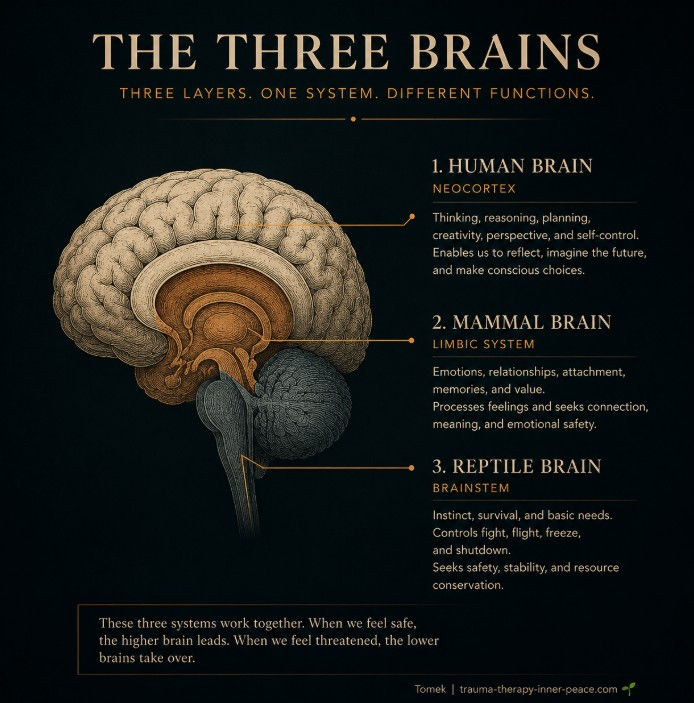
The amygdala — the brain's alarm centre — becomes hyperreactive. It responds intensely and quickly (within 12 milliseconds) to stimuli associated with threat — often before consciousness has time to process anything. That's why traumatic reactions are automatic, not conscious.
The hippocampus — the structure responsible for memory and temporal context — functions more poorly under chronic cortisol. Traumatic memories aren't properly "date-stamped." That's why a flashback doesn't feel like a memory from the past — it feels like the present.
The prefrontal cortex — the centre of rational thinking and emotional regulation — gets "switched off" when the amygdala takes over. That's why in moments of intense triggering it's hard to think clearly and make good decisions.
The HPA axis (hypothalamus-pituitary-adrenal) — the cortisol regulation system — becomes dysregulated by prolonged stress. This results in both states of chronic arousal and states of numbness and exhaustion.
The autonomic nervous system loses flexibility — instead of fluidly moving between activation and rest, it "gets stuck" in one of two extreme states: chronic tension (hyperarousal) or chronic freezing (hypoarousal).
These changes are real and measurable. But — and this is crucial — the brain is neuroplastic throughout life. Appropriate therapeutic and regulatory experiences can reverse these changes.
7. Stages of therapeutic work {#stages}
Trauma therapy — both PTSD and C-PTSD — doesn't involve "digging up the past by force." It's a process with a clear structure, conducted at a pace adapted to you.
The standard three-phase model of trauma treatment (Herman, 1992) includes:
Phase 1 — Safety and Stabilisation
Before anything can be processed, a sense of safety must be established — in the body, in the therapeutic relationship, in daily life.
This phase includes:
Learning to recognise signals from the body and states of the nervous system
Emotional regulation techniques and reducing arousal
Building resources — internal and external
Psychoeducation — understanding what's happening and why
Stabilising day-to-day functioning
For people with C-PTSD, this phase may last much longer — and that's normal and appropriate. You can't build on an unstable foundation.
Phase 2 — Processing Traumatic Experiences
Only when sufficient safety has been achieved does gradual, controlled approach to traumatic experiences begin.
The goal of this phase isn't "telling the story" — it's changing the way trauma is stored in the nervous system. Integrating fragmentary, intense memories into a coherent narrative that can be "placed in the past."
This phase is conducted at the pace of your nervous system — no faster.
Phase 3 — Integration and Building a New Life
Incorporating experiences into your own story. Building new patterns, new relationships, a new understanding of yourself — not in spite of trauma, but with it as part of the history that shaped the person you are.
This phase is also the time for building healthier boundaries, developing self-worth, and creating a life more aligned with what you genuinely want.
8. Therapy Methods — What works and why {#methods}
CPT — Cognitive Processing Therapy
CPT focuses on identifying and changing "stuck points" — beliefs that arose from trauma and that hinder healing. Typical stuck points: "it was my fault," "I don't deserve help," "the world is always dangerous," "no one can be trusted."
CPT is one of the most thoroughly researched methods for PTSD. It also works for C-PTSD — though it requires prior stabilisation.
PE — Prolonged Exposure
Prolonged Exposure involves gradual, controlled approach to avoided memories and situations. It's based on the mechanism of habituation — safe confrontation with a stimulus reduces its intensity.
PE is particularly effective for PTSD with a clearly identified traumatic event.
EMDR
Eye Movement Desensitisation and Reprocessing uses bilateral stimulation (alternating eye movements, sounds, or touch) while recalling traumatic memories. The mechanism isn't yet fully understood, but clinical effects are very well documented — for both PTSD and C-PTSD.
EMDR is particularly effective when it's hard to isolate one specific event — precisely in complex relational trauma.
Somatic Experiencing (SE)
Peter Levine's method works with bodily sensations rather than narrative. It focuses on the process of discharging tension stored in the nervous system — slowly, safely, following the body's signals.
SE is particularly helpful when trauma is deeply somatic or when access to words and narrative is difficult.
Internal Family Systems (IFS)
IFS works with internal "parts" — aspects of the psyche that developed in response to trauma: the inner critic, the protective part, the part carrying pain. The goal is to establish dialogue between these parts and your deeper Self.
IFS is particularly effective for C-PTSD and complex relational trauma — where identity is deeply disrupted.
9. What you feel makes sense — normalising symptoms {#normalising}
One of the most important steps in the healing process is understanding that your reactions are not random or "crazy."
If you feel anxiety — perhaps it once was needed to protect you
If you avoid closeness — perhaps it once was a source of pain
If it's hard to trust — perhaps trust was once violated
If you react intensely to "small" things — perhaps your nervous system learned that small signals could herald great danger
Your mechanisms are not "bad." They once worked. They once protected you.
The problem is that today they may no longer be needed — yet they still direct your life, often without your awareness.
Good news: you can learn new ways of responding. The nervous system can be regulated. A sense of safety can be rebuilt. Beliefs about yourself can change.
The brain's neuroplasticity works throughout life. This isn't empty optimism — it's neuroscience.
10. Self-Assessment: PTSD or C-PTSD? {#self-assessment}
The following questions are not a diagnosis. They are an invitation to reflection. If several of them feel familiar — it's worth speaking with a specialist.
Symptoms more typical of PTSD:
There is a specific event from the past that "won't leave you alone"
You have flashbacks or intrusive memories related to that event
You avoid specific places, people, or situations associated with the event
Your symptoms clearly began after that event
Symptoms more typical of C-PTSD:
It's hard to point to one specific event — more like an entire childhood or a long period
You have chronic shame and a belief that you're "broken" or "not enough"
Your sense of identity feels unstable — you don't know who you are outside the roles you play
Your relationships are chronically disrupted — the same patterns keep repeating
You have difficulty regulating emotions — intense states that are hard to exit
In both cases there may be:
Chronic muscle tension
Sleep problems
Concentration difficulties
A sense of disconnection from yourself or others
Emotional reactions disproportionate to the situation
11. The first step towards change {#first-step}
Recognising that what you're feeling may have a connection to the past — that's an enormously important moment.
You don't need to have all the answers. You don't need to know immediately what to do.
One step is enough. It might be:
Reading this article to the end — that's already a step
Writing down your observations — what from the above resonates?
A conversation with someone you trust
A first consultation with a specialist — it doesn't commit you to anything, it's simply a conversation
You don't have to deal with this alone.
Support exists — and it's available.
12. FAQ — Frequently Asked Questions {#faq}
Can someone have both PTSD and C-PTSD at the same time? Yes. A person with a history of prolonged trauma (C-PTSD) may additionally experience an acute traumatic event that layers on as PTSD. In clinical practice these pictures often overlap — which underscores the importance of thorough diagnostic assessment.
Can PTSD and C-PTSD be cured? "Cured" is a word that requires care. The goal of therapy isn't to "erase" the past — but to change the way it's stored and experienced. Most people after effective therapy describe significant reduction in symptoms and recovery of a sense of agency. Trauma becomes part of the story — not a force steering life.
How long does therapy take for PTSD vs C-PTSD? PTSD using CPT or EMDR — typically 12–20 sessions for a single traumatic event. C-PTSD — significantly longer, because it requires a multi-phase process: first stabilisation, then processing. Work may last from one to several years. This isn't a reason for discouragement — it's a description of the complexity and depth of the work.
Do I need an official diagnosis to seek help? No. A diagnosis is helpful — it helps the therapist choose the right approach. But to contact a specialist you don't need a "certificate." It's enough that you feel you need help.
How do you distinguish C-PTSD from borderline personality disorder (BPD)? This is an important question, because for years many people with C-PTSD were incorrectly diagnosed with BPD. Both diagnoses have overlapping symptoms: difficulties with emotional regulation, unstable identity, relational problems. The difference lies in aetiology — C-PTSD is always rooted in a trauma history. A good trauma diagnostician and therapist will be able to make this distinction.
Does online therapy work for PTSD and C-PTSD? Yes — research confirms the effectiveness of online therapy, including CPT and EMDR, for trauma. What matters is a sense of safety and privacy in the session location. Online therapy can be particularly helpful for people who find it hard to leave home or who live far from therapy centres.
What's the difference between trauma and "ordinary" stress? Stress is a response to demands that exceed current resources — but remains within the nervous system's tolerance window and subsides when the demand passes. Trauma is an experience so overwhelming that the nervous system couldn't process it in the moment it occurred. It remains "frozen" and continues to affect functioning — even when the external situation is safe.
Closing
PTSD and C-PTSD are two different, though related, ways the nervous system responds to experiences it couldn't bear.
One event can change a great deal. Years of difficult experiences can shape life in subtle but profound ways.
Regardless of what you've experienced — your reactions make sense. And change is possible.
The healing process takes time — but every step towards it matters. And you don't have to go through it alone.
First contact doesn't commit you to anything — it's simply a conversation from which change can begin.
Tomek Maciaszek — certified psychotraumatologist, CPT and PE specialist, Mindfulness practitioner. Working in Gdynia and online, in Polish and English.


Comments